


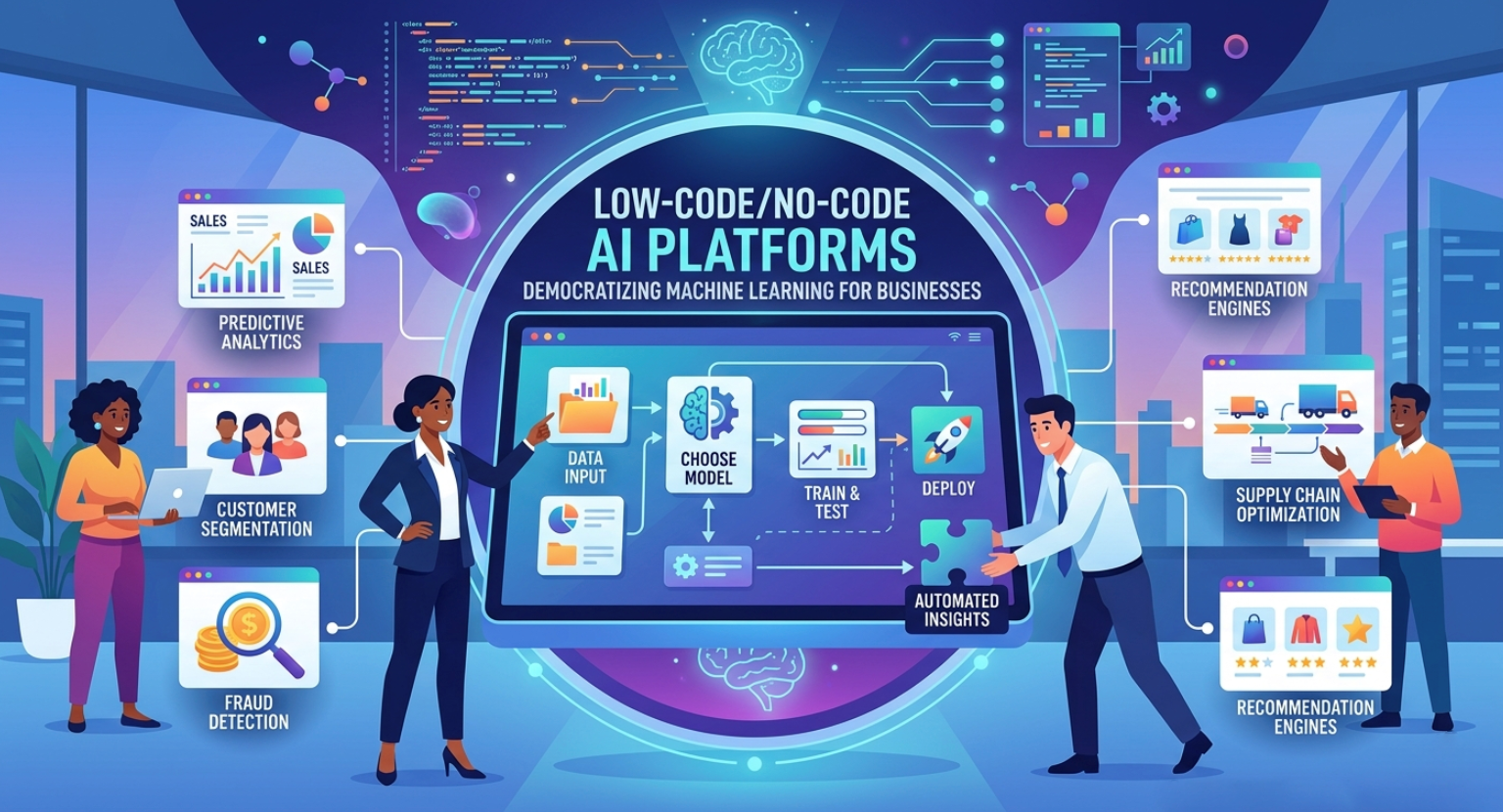
Low-Code/No-Code AI Platforms: Democratizing Machine Learning for Businesses
Artificial intelligence has rapidly become a strategic priority for enterprises seeking to innovate, optimize operations, and gain competitive advantage. However, traditional AI development often requires specialized expertise, significant resources, and long development cycles creating barriers for many organizations.
Low-code and no-code AI platforms are transforming this landscape by enabling businesses to build, deploy, and scale machine learning solutions with minimal coding. These platforms empower non-technical users, accelerate development timelines, and reduce dependency on highly specialized talent.
In this blog, we explore how low-code/no-code AI platforms are democratizing machine learning, their benefits, enterprise use cases, challenges, and how organizations can leverage them effectively.
Understanding Low-Code and No-Code AI Platforms
Low-code and no-code AI platforms are tools that simplify the process of building AI models and applications.
- Low-code platforms require minimal programming knowledge and provide pre-built components, templates, and visual workflows.
- No-code platforms enable users to build AI solutions entirely through graphical interfaces without writing code.
These platforms abstract complex processes such as data preprocessing, model training, and deployment making AI accessible to a broader audience.
Why Democratizing AI Matters for Businesses
Historically, AI adoption has been limited to organizations with access to skilled data scientists and large budgets. Low-code/no-code platforms break down these barriers by:
- Enabling business users to create AI solutions independently
- Reducing development time from months to days or weeks
- Lowering costs associated with AI implementation
- Encouraging innovation across departments
Democratizing AI allows organizations to scale innovation and embed intelligence into everyday business processes.
Key Features of Low-Code/No-Code AI Platforms
Visual Development Interfaces: Drag-and-drop interfaces allow users to design workflows, build models, and deploy solutions without writing code.
Pre-Built Models and Templates: Platforms provide ready-to-use models for common use cases such as forecasting, classification, and recommendation systems.
Automated Machine Learning (AutoML): AutoML capabilities automate model selection, training, and optimization.
Data Integration: Seamless integration with databases, APIs, and cloud platforms simplifies data ingestion.
Deployment and Monitoring: Users can deploy models directly and monitor performance in real time.
Benefits for Enterprises
Faster Time-to-Market: Organizations can rapidly develop and deploy AI applications without lengthy development cycles.
Cost Efficiency: Reduced reliance on specialized talent lowers overall implementation costs.
Increased Productivity: Business teams can automate processes and make data-driven decisions without waiting for technical teams.
Enhanced Collaboration: Low-code platforms bridge the gap between business and technical teams.
Scalability: Organizations can scale AI initiatives across departments and use cases.
Enterprise Use Cases
Low-code/no-code AI platforms are being adopted across industries to solve real-world challenges.
Customer Experience Enhancement: Businesses use AI to analyze customer behavior, personalize interactions, and improve engagement.
Sales and Marketing Optimization: AI models help predict customer preferences, optimize campaigns, and increase conversion rates.
Financial Forecasting: Organizations leverage AI for revenue forecasting, risk analysis, and budgeting.
HR and Talent Management: AI-driven tools assist in recruitment, employee engagement, and performance analysis.
Operations and Process Automation: AI automates repetitive tasks, improving efficiency and reducing errors.
Popular Low-Code/No-Code AI Platforms
Several platforms are leading the adoption of low-code/no-code AI solutions:
- Microsoft Power Platform: Enables AI-driven app development with minimal coding
- Google AutoML: Provides automated model building and deployment
- IBM Watson Studio: Offers tools for data science and AI development
- DataRobot: Focuses on automated machine learning for enterprises
- H2O.ai: Delivers open-source AI and AutoML solutions
These platforms cater to a wide range of business needs and technical capabilities.
Challenges and Limitations
While low-code/no-code AI platforms offer significant advantages, they also come with limitations.
Limited Customization: Pre-built models may not fully address complex or highly specific use cases.
Data Dependency: The quality of AI outputs depends heavily on the quality of input data.
Governance and Security Concerns: Organizations must ensure proper data governance and compliance.
Scalability Constraints: Some platforms may face limitations when handling large-scale or complex workloads.
Skill Gaps: While coding requirements are reduced, users still need a basic understanding of AI concepts.
Best Practices for Implementation
To maximize the benefits of low-code/no-code AI platforms, organizations should follow best practices:
- Start with clearly defined use cases
- Ensure high-quality, well-structured data
- Provide training for business users
- Establish governance frameworks for AI usage
- Integrate platforms with existing systems and workflows
A strategic approach ensures successful adoption and long-term value.
The Future of Democratized AI
Low-code/no-code AI platforms are expected to play a critical role in the future of enterprise technology.
Key trends include:
- Increased adoption of AutoML and intelligent automation
- Integration with emerging technologies like IoT and edge computing
- Enhanced collaboration between business and technical teams
- Expansion of AI capabilities across all business functions
As these platforms evolve, they will further empower organizations to innovate and compete in a data-driven world.
Final Thoughts
Low-code and no-code AI platforms are revolutionizing how businesses approach artificial intelligence. By making AI accessible to non-technical users, these platforms enable faster innovation, reduce costs, and unlock new opportunities across industries.
Organizations that embrace democratized AI can accelerate digital transformation and build intelligent systems that drive measurable business outcomes.
If you’re looking to implement low-code/no-code AI solutions or scale your AI initiatives, Swayam Infotech can help you design and deploy tailored AI strategies that align with your business goals.