


Zero-Trust Architecture Meets AI: Strengthening Modern Security Frameworks
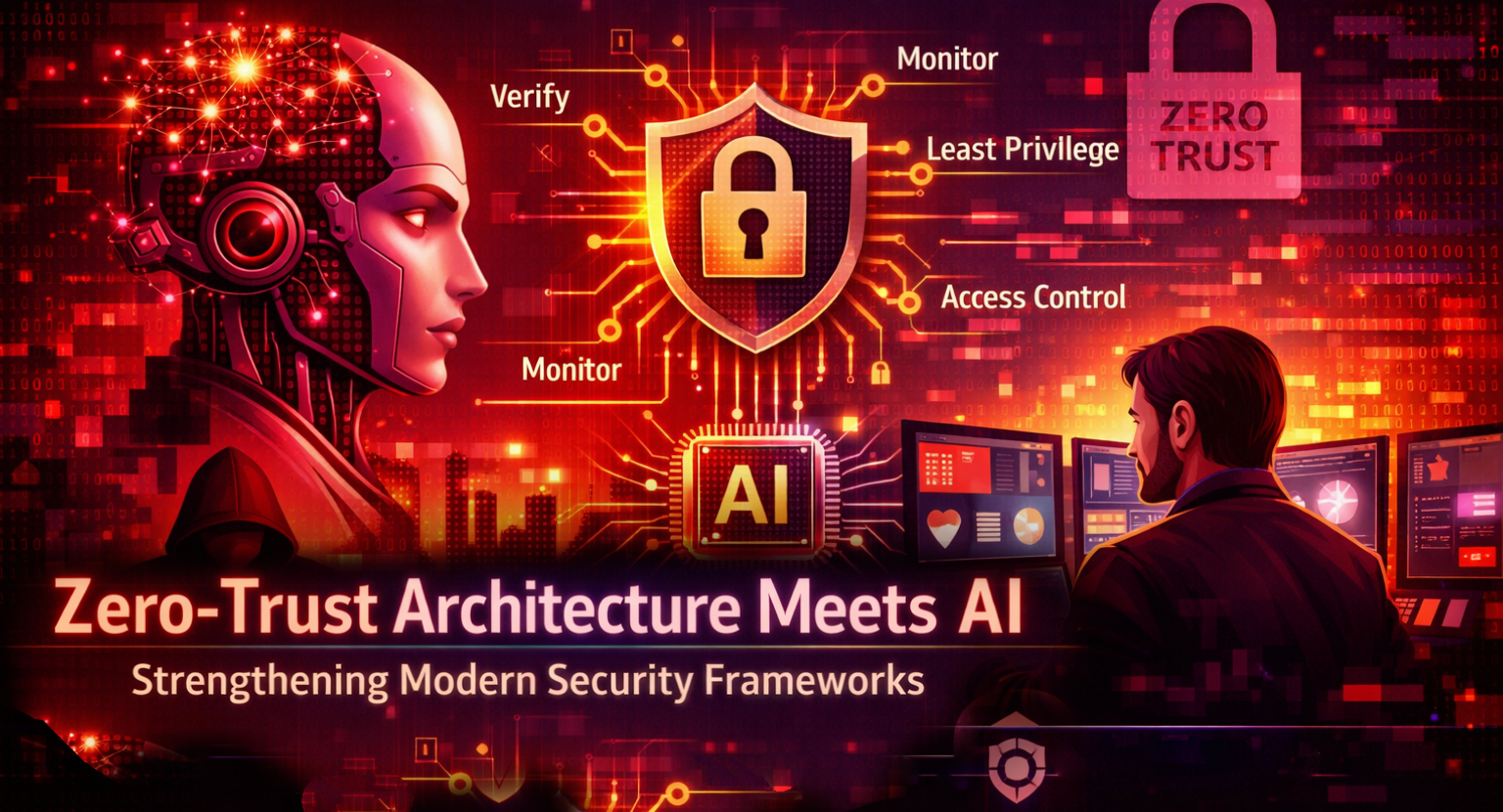
As organizations expand their digital footprint across cloud environments, remote workforces, and distributed systems, traditional perimeter-based security models are becoming increasingly ineffective. The assumption that everything inside a network can be trusted no longer holds true in today’s threat landscape.
This shift has led to the adoption of Zero-Trust Architecture (ZTA) , a security model based on the principle of “never trust, always verify.” At the same time, artificial intelligence is emerging as a powerful enabler of advanced threat detection and real-time decision-making.
When combined, Zero-Trust and AI create a robust, adaptive security framework capable of identifying threats, enforcing policies dynamically, and continuously learning from new attack patterns.
In this blog, we explore how Zero-Trust Architecture and AI work together, the technologies driving this integration, enterprise use cases, benefits, challenges, and what this means for modern security strategies.
Understanding Zero-Trust Architecture
Zero-Trust Architecture is a cybersecurity approach that assumes no user, device, or system should be trusted by default regardless of whether it is inside or outside the network.
Instead, access is granted based on strict verification processes, including:
- Identity authentication
- Device validation
- Context-aware access controls
- Continuous monitoring and verification
This model ensures that every request is evaluated before access is granted, reducing the risk of unauthorized access and lateral movement within systems.
The Role of AI in Modern Security
Artificial intelligence enhances security systems by enabling them to detect patterns, analyze large volumes of data, and respond to threats in real time.
AI-powered security systems can:
- Identify anomalies in user behavior
- Detect suspicious network activity
- Predict potential security threats
- Automate incident response
- Continuously improve through learning
By integrating AI into security frameworks, organizations can move from reactive defense to proactive threat prevention.
Why Zero-Trust Needs AI
While Zero-Trust provides a strong security foundation, implementing it at scale can be complex due to the volume of users, devices, and interactions.
AI plays a critical role in making Zero-Trust practical and scalable by:
- Automating identity verification and access decisions
- Analyzing behavioral patterns across systems
- Reducing manual intervention in security operations
- Enhancing real-time threat detection
This combination allows organizations to enforce strict security policies without compromising efficiency.
How AI Enhances Zero-Trust Architecture
AI can be integrated across multiple layers of a Zero-Trust framework.
Intelligent Identity and Access Management
AI analyzes user behavior, location, and device data to enable adaptive authentication and dynamic access control.
Continuous Monitoring and Threat Detection
AI continuously monitors network activity to detect anomalies and potential threats in real time.
Behavioral Analytics
Machine learning models identify deviations from normal behavior, helping detect insider threats and compromised accounts.
Automated Incident Response
AI systems can automatically respond to security incidents by isolating affected systems or blocking suspicious activity.
Risk-Based Access Decisions
AI evaluates contextual data to determine the level of risk associated with each access request.
Enterprise Use Cases
The integration of Zero-Trust and AI is transforming security across industries.
Financial Services
Organizations use AI-driven Zero-Trust frameworks to detect fraud, secure transactions, and protect sensitive data.
Healthcare Systems
Hospitals implement Zero-Trust to safeguard patient data while using AI to detect anomalies in system access.
Remote Workforce Security
Enterprises secure remote access by verifying user identity and device health continuously.
Cloud Infrastructure Protection
AI-enhanced Zero-Trust models secure multi-cloud environments and prevent unauthorized access.
Critical Infrastructure
Industries such as energy and manufacturing use Zero-Trust and AI to protect operational systems from cyber threats.
Benefits of Combining Zero-Trust and AI
- Enhanced Security Posture: Continuous verification reduces the risk of unauthorized access.
- Real-Time Threat Detection: AI enables immediate identification and response to threats.
- Scalability: AI automates security processes, making Zero-Trust feasible at scale.
- Reduced Human Error: Automation minimizes manual intervention and associated risks.
- Improved Compliance: Strong security controls help meet regulatory requirements.
Challenges in Implementation
Despite its advantages, integrating AI with Zero-Trust Architecture presents challenges.
- Complexity of deployment across large systems
- Integration with legacy infrastructure
- Data privacy and governance concerns
- Requirement for skilled cybersecurity expertise
- Balancing security with user experience
Organizations must carefully plan and execute their strategies to address these challenges.
The Future of AI-Driven Zero-Trust Security
The future of cybersecurity lies in adaptive, intelligent systems that can respond to threats dynamically.
Emerging trends include:
- Autonomous security operations powered by AI
- Continuous risk assessment and adaptive access control
- Integration with extended detection and response (XDR) systems
- AI-driven policy optimization
- Self-healing security architectures
These advancements will further strengthen the effectiveness of Zero-Trust frameworks.
Final Thoughts
Zero-Trust Architecture and AI together represent a powerful approach to modern cybersecurity. By combining strict access controls with intelligent threat detection, organizations can build security frameworks that are both robust and adaptable.
As cyber threats continue to evolve, adopting AI-driven Zero-Trust strategies will be essential for protecting digital assets, ensuring compliance, and maintaining trust in an increasingly connected world.
If your organization is looking to implement advanced security frameworks, enhance threat detection, or build scalable AI-driven systems, partnering with the right technology experts can make a significant difference. At Swayam Infotech, we help businesses design and deploy intelligent security solutions tailored to modern enterprise needs.