


AI Model Fine-Tuning vs. Prompt Engineering: Choosing the Right Strategy for Your Use Case
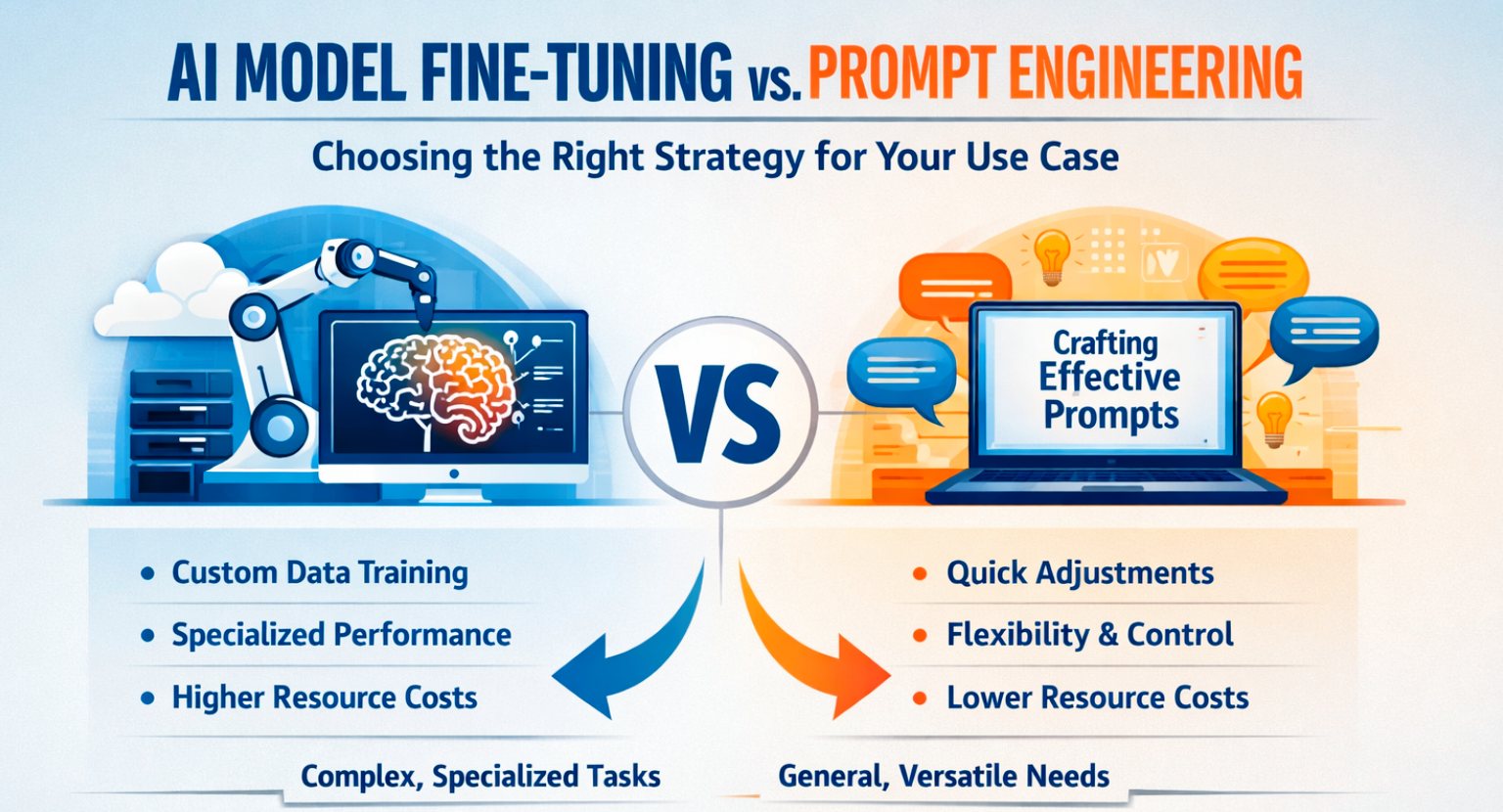
As artificial intelligence becomes more integrated into enterprise applications, organizations often face an important decision: Should they fine-tune an AI model or rely on prompt engineering to achieve desired results?
Both approaches aim to improve how AI systems perform specific tasks. However, they differ significantly in terms of cost, complexity, scalability, and implementation time. Understanding the differences between these two strategies helps businesses select the most effective approach for their use cases.
In this blog, we explore what fine-tuning and prompt engineering are, how they work, their advantages and limitations, and how enterprises can determine which strategy is best suited for their AI applications.
Understanding Prompt Engineering
Prompt engineering is the process of designing and optimizing prompts (instructions) to guide an AI model in producing more accurate and relevant outputs.
Instead of modifying the AI model itself, developers adjust how they communicate with the model through carefully structured prompts.
For example, rather than asking an AI model a general question, prompt engineering provides:
-
Clear instructions
-
Contextual information
-
Examples of desired outputs
-
Structured formatting
These improvements help the AI generate better responses without altering the model’s underlying parameters.
Benefits of Prompt Engineering
Prompt engineering has become widely popular because it offers several advantages:
Faster Implementation: Prompt engineering does not require retraining the AI model. Developers can immediately improve outputs by adjusting prompts.
Lower Cost: Since no additional training infrastructure is required, prompt engineering is typically much more cost-effective than fine-tuning.
Flexibility: Prompts can easily be updated or modified as business requirements evolve.
Ideal for Rapid Prototyping: Organizations experimenting with AI applications often begin with prompt engineering to validate ideas quickly.
Limitations of Prompt Engineering
Despite its benefits, prompt engineering also has some limitations:
-
Performance may vary depending on prompt quality
-
Complex workflows may require long prompts
-
Output consistency can sometimes be difficult to maintain
-
Some highly specialized tasks may exceed the model’s capabilities
When applications require high precision or domain-specific expertise, prompt engineering alone may not be sufficient.
Understanding AI Model Fine-Tuning
Fine-tuning involves training an existing AI model on a specialized dataset so that it performs better on specific tasks.
Rather than relying only on prompts, fine-tuning modifies the model’s internal parameters, enabling it to better understand domain-specific patterns and terminology.
For example, a healthcare company might fine-tune a model using:
-
Medical research data
-
Clinical documentation
-
Healthcare terminology
This process allows the model to generate more accurate responses for medical applications.
Benefits of Fine-Tuning
Fine-tuning offers several advantages for enterprise AI deployments.
Improved Accuracy: Fine-tuned models often produce more reliable outputs for specialized tasks.
Domain Expertise: Training on industry-specific datasets helps models understand complex terminology and workflows.
Consistent Results: Fine-tuned models tend to provide more predictable and consistent responses.
Better Performance in Complex Applications: Applications such as fraud detection, legal analysis, or financial modeling may benefit from fine-tuned models.
Limitations of Fine-Tuning
Fine-tuning also introduces certain challenges.
Higher Cost: Training models require computational resources, infrastructure, and high-quality datasets.
Longer Development Time: Fine-tuning involves data preparation, training cycles, and validation processes.
Maintenance Requirements: Models may need to be retrained periodically to stay up to date with new data.
Data Privacy Considerations: Organizations must ensure that training datasets comply with privacy and regulatory requirements.
When to Use Prompt Engineering
Prompt engineering is often the best choice when:
-
Building early-stage AI prototypes
-
Creating chatbots or content generation tools
-
Automating simple workflows
-
Working with general-purpose tasks
-
Reducing development costs
Many organizations successfully deploy AI applications using prompt engineering alone.
When to Use Fine-Tuning
Fine-tuning becomes valuable when:
-
High accuracy is critical
-
Tasks involve specialized industry knowledge
-
Large-scale production systems require consistent outputs
-
Organizations have access to high-quality training datasets
-
AI systems must handle complex workflows
Fine-tuning is commonly used in industries such as healthcare, finance, and legal technology.
Hybrid Approach: Combining Both Strategies
In many cases, the most effective solution involves combining prompt engineering with fine-tuning.
This hybrid approach allows organizations to:
-
Fine-tune models for domain-specific knowledge
-
Use prompt engineering for flexible interaction
-
Improve performance while maintaining adaptability
Hybrid strategies are increasingly common in enterprise AI systems.
Enterprise Use Cases
Customer Support Automation: Prompt engineering can help build AI-powered chatbots that answer frequently asked questions. Fine-tuning may be used to improve responses for company-specific policies and product details.
Document Analysis: Legal or financial document analysis often benefits from fine-tuned models trained on industry-specific data.
Marketing Content Generation: Prompt engineering works well for generating marketing content, product descriptions, and blog posts.
Fraud Detection Systems: Financial institutions often use fine-tuned AI models to detect complex fraud patterns.
Future Trends in AI Customization
As AI technology evolves, new techniques are emerging that combine the benefits of both strategies.
These include:
-
Parameter-efficient fine-tuning methods
-
Retrieval-augmented generation (RAG) systems
-
Adaptive prompt optimization
-
Smaller domain-specific models
These innovations are making AI customization more efficient and accessible for enterprises.
Choosing the Right Strategy
Selecting the best approach depends on several factors:
-
Business objectives
-
Budget constraints
-
Dataset availability
-
Required accuracy levels
-
Development timelines
Organizations should evaluate these factors carefully before deciding whether to use prompt engineering, fine-tuning, or a combination of both.
Final Thoughts
Both prompt engineering and model fine-tuning play critical roles in modern AI development. Prompt engineering offers a fast and cost-effective way to guide AI behavior, while fine-tuning provides deeper customization and improved accuracy for specialized tasks.
The most successful AI implementations often leverage both strategies together, balancing flexibility with performance.
As AI adoption continues to grow across industries, understanding these approaches will help organizations design smarter, more efficient AI systems that align with their business goals.
If your organization is exploring custom AI solutions or intelligent automation platforms, working with experienced AI developers can ensure optimal performance and scalability. At Swayam Infotech, we help businesses build advanced AI applications tailored to their unique requirements.