


AI-Powered Digital Twins: Simulating the Future Before It Happens
In today’s fast-moving digital economy, organizations are constantly seeking ways to make better decisions, reduce risks, and optimize performance. Traditional data analytics provides valuable insights about past and present conditions, but modern businesses increasingly need the ability to simulate future scenarios before they occur.
This is where AI-powered digital twins are transforming industries.
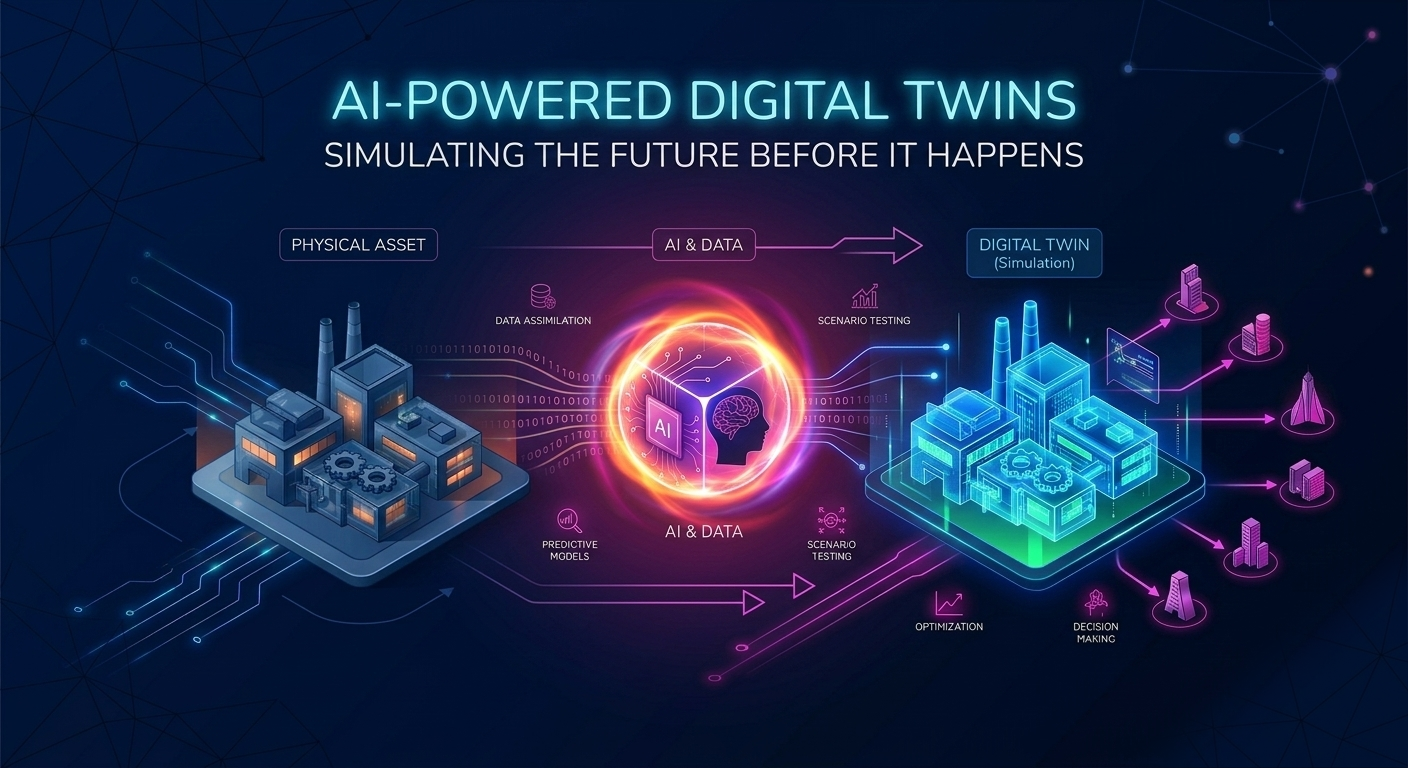
A digital twin is a virtual replica of a physical object, system, process, or environment that mirrors real-world conditions in real time. When combined with artificial intelligence and advanced analytics, digital twins become powerful simulation tools capable of predicting outcomes, testing strategies, and optimizing operations.
From manufacturing plants and smart cities to healthcare systems and supply chains, AI-powered digital twins allow organizations to experiment safely in a virtual environment before implementing changes in the real world.
In this blog, we explore what AI-powered digital twins are, how they work, their benefits, real-world applications, and how businesses can leverage them to make smarter and more informed decisions.
What Are Digital Twins?
A digital twin is a virtual representation of a physical asset, system, or process that continuously receives data from its real-world counterpart.
This virtual model replicates the behavior, performance, and conditions of the physical entity using real-time data from sensors, IoT devices, and operational systems.
For example, a digital twin of a factory machine can simulate how the machine operates, track wear and tear, and predict potential failures before they occur.
Digital twins bridge the gap between the physical and digital worlds by providing a real-time mirror of real-world systems.
The Role of AI in Digital Twin Technology
While basic digital twins rely on data visualization and monitoring, adding artificial intelligence significantly enhances their capabilities.
AI enables digital twins to:
- Analyze complex datasets
- Detect patterns and anomalies
- Predict future outcomes
- Simulate multiple scenarios
- Recommend optimal decisions
By combining AI with digital twins, organizations gain a predictive and prescriptive decision-making tool rather than a simple monitoring system.
This integration allows businesses to explore “what-if” scenarios and optimize processes before making real-world changes.
How AI-Powered Digital Twins Work
AI-powered digital twins operate through a combination of interconnected technologies.
Data Collection
Sensors, IoT devices, and operational systems collect real-time data from physical assets or environments.
Examples include:
- Temperature readings
- Equipment performance metrics
- Environmental conditions
- Operational parameters
This data feeds into the digital twin platform.
Virtual Model Creation
The collected data is used to build a dynamic virtual representation of the physical asset or system. The digital model updates continuously as new data arrives, ensuring it accurately reflects real-world conditions.
AI-Based Analysis
Machine learning algorithms analyze the incoming data to identify trends, patterns, and anomalies. This analysis enables the system to understand how the real-world asset behaves under different conditions.
Simulation and Prediction
The digital twin runs simulations to predict how the system will respond to future changes. Organizations can test different strategies or conditions in the virtual environment before implementing them physically.
Decision Optimization
Based on simulation results, the system can recommend optimal actions to improve performance, efficiency, or safety. This predictive intelligence helps organizations make better decisions faster.
Key Benefits of AI-Powered Digital Twins
Predictive Insights: Digital twins allow organizations to anticipate future problems or opportunities before they occur. For example, predictive maintenance models can detect equipment failure risks early.
Reduced Operational Risks: Testing changes in a virtual environment reduces the risk of costly real-world mistakes. Businesses can simulate scenarios such as equipment upgrades, process adjustments, or infrastructure changes.
Improved Efficiency: AI-driven simulations help optimize workflows, resource usage, and operational performance. This leads to better productivity and cost savings.
Faster Innovation: Organizations can experiment with new ideas in a digital environment without disrupting real-world operations. This accelerates innovation cycles.
Data-Driven Decision Making: Digital twins provide a comprehensive view of systems and processes, enabling more informed decision-making.
Real-World Applications of AI-Powered Digital Twins
Manufacturing
Manufacturers use digital twins to simulate production lines, monitor equipment health, and optimize supply chain operations. AI-powered twins help reduce downtime, improve product quality, and increase production efficiency.
Smart Cities
Urban planners use digital twins to simulate city infrastructure, traffic patterns, and energy consumption. This allows governments to test urban development strategies before implementing them in the real world.
Healthcare
Hospitals and research institutions use digital twins to model patient health conditions, medical equipment, and hospital workflows. These simulations help improve treatment strategies and operational efficiency.
Energy and Utilities
Energy companies use digital twins to monitor power grids, wind turbines, and energy distribution networks. AI simulations help optimize energy production and predict infrastructure failures.
Transportation and Logistics
Logistics companies use digital twins to model transportation networks, warehouse operations, and delivery routes. AI-driven simulations help improve efficiency and reduce delivery times.
Digital Twins and the Internet of Things (IoT)
Digital twins are closely connected to the growth of IoT ecosystems. IoT devices provide the continuous data streams that keep digital twins updated and accurate.
Examples include:
- Smart sensors in industrial machines
- Environmental sensors in cities
- Wearable devices in healthcare
- Vehicle telemetry systems in transportation
AI processes these massive data streams and converts them into meaningful insights.
Challenges in Implementing Digital Twins
Despite their potential, deploying digital twin technology can present challenges.
Data Integration Complexity: Organizations must integrate data from multiple systems, sensors, and platforms.
Infrastructure Requirements: Digital twin platforms require powerful computing resources to process real-time data and run simulations.
Data Security and Privacy: Protecting sensitive operational and personal data is essential.
Model Accuracy: Digital twins must accurately represent real-world systems to provide reliable insights. Organizations must continuously refine models using updated data.
Best Practices for Implementing AI-Powered Digital Twins
Businesses can maximize the value of digital twins by following several best practices.
Start with High-Value Use Cases: Focus on areas where simulation and predictive insights deliver the most value.
Build Strong Data Foundations: Reliable data collection and integration are essential for accurate simulations.
Combine AI with Domain Expertise: Industry knowledge is critical for interpreting simulation results effectively.
Implement Scalable Infrastructure: Cloud-based platforms enable organizations to scale digital twin systems as needed.
Maintain Continuous Monitoring: Digital twins should evolve alongside their physical counterparts through continuous data updates.
The Future of AI-Powered Digital Twins
The digital twin market is expected to grow rapidly as organizations seek smarter ways to manage complex systems.
Emerging trends include:
- Autonomous digital twin ecosystems
- Real-time city-scale simulations
- AI-driven industrial automation
- Digital twin platforms for healthcare and personalized medicine
- Integration with augmented and virtual reality environments
These innovations will further expand the potential of digital twins across industries.
Final Thoughts: Simulating Tomorrow’s Decisions Today
AI-powered digital twins are transforming how organizations plan, operate, and innovate. By creating virtual replicas of real-world systems and enabling predictive simulations, digital twins allow businesses to experiment with future scenarios safely and efficiently.
As industries become more data-driven and interconnected, digital twins will play a central role in optimizing operations, reducing risks, and accelerating innovation.
If you’re planning to build AI-powered simulation platforms, IoT-driven analytics systems, or intelligent digital twin solutions, partnering with experienced AI developers ensures scalable and secure implementation. At Swayam Infotech, we specialize in designing advanced AI applications that help businesses transform real-world data into actionable insights.