Technical Reasoning Loops: ReAct, ReWOO, and CoT Patterns in Production

AI Overview
In production environments, Large Language Models (LLMs) require structured reasoning loops to move beyond simple chat interactions. Chain-of-Thought (CoT) provides the logical foundation, ReAct (Reason + Act) enables iterative tool usage, and ReWOO (Reasoning Without Observation) optimizes for latency and cost by planning before execution. Understanding these patterns is essential for CTOs and COOs scaling Agentic AI Systems within enterprise infrastructures.
The Reliability Gap in Enterprise AI
Most enterprise AI pilots fail because they rely on "zero-shot" prompting. When an LLM is asked to perform a complex task, like reconciling a multi-million dollar ledger or managing a supply chain, it often takes the path of least resistance. This leads to hallucinations.
At Agix Technologies, we don't build "chatbots." We build reasoning systems. To achieve 99.9% reliability, we implement advanced reasoning loops that force the model to validate its own logic before committing to an output.
Chain-of-Thought (CoT): The Foundation of Logic
Chain-of-Thought reasoning is the process of prompting a model to "show its work." Instead of jumping from input to output, the model generates intermediate steps.
The Challenge: LLMs are essentially advanced statistical predictors. Without CoT, they frequently skip logical nuances, resulting in high hallucination rates in complex math or symbolic reasoning tasks.
The Result: By implementing CoT, we see a 40-60% reduction in logic-based errors. The model identifies its own errors during the "thought" process.
The Impact: Production systems become more transparent. If a system fails, the logs show exactly where the logic deviated, allowing for rapid debugging and refinement.
ReAct: Bridging Reasoning and Action
The ReAct (Reason + Act) pattern is the gold standard for AI Automation. It combines internal reasoning with external tool usage.
The ReAct Workflow Example:
- Thought: "The user wants to know the current stock price of NVIDIA. I need to access a financial data tool."
- Observation: "NVDA is trading at $890.45."
- Thought: "I have the data. Now I need to compare it to the 52-week high."
- Observation: "52-week high is $974.00."
- Final Response: "NVIDIA is currently at $890.45, which is 8.6% below its 52-week high."
The Challenge: Standard RAG (Retrieval-Augmented Generation) is often static. It fetches data once and hopes for the best.
The Result: ReAct allows the agent to pivot based on what it finds. If a search result is missing a key piece of information, the agent "reasons" that it needs to search again with a different query.
The Impact: Autonomous agents capable of handling non-linear workflows. This is the architecture we used in our HouseCanary Case Study to handle massive datasets with high precision.
ReWOO: Reasoning Without Observation for Scale
While ReAct is powerful, it is also slow and expensive. Every "Thought" and "Action" requires a new call to the LLM API, increasing latency and token consumption.
ReWOO (Reasoning Without Observation) solves this by decoupling the reasoning plan from the tool execution.
The Strategy:
- Planner: The LLM looks at the task and creates a full blueprint of steps and tool calls, using placeholders for data it doesn't have yet.
- Worker: All tool calls are executed in parallel.
- Solver: The LLM takes all the gathered data and generates the final response.
The Result: A 50-70% reduction in latency and significant token cost savings. Because the model isn't "thinking" after every single tool call, the number of sequential API turns is minimized.
The Impact: High-speed agentic systems that scale without breaking the bank. This is critical for Conversational AI Chatbots that require sub-second response times.
Comparison of Reasoning Patterns
| Feature | Chain-of-Thought (CoT) | ReAct (Reason + Act) | ReWOO (Reasoning Without Observation) |
|---|---|---|---|
| Primary Use Case | Internal logic, Math | Dynamic tool interaction | High-latency/Cost-sensitive tasks |
| Tool Usage | None | Iterative/Sequential | Parallel/Planned |
| Latency | Low | High (Sequential turns) | Medium (Parallel execution) |
| Cost | Low | High | Medium |
| Hallucination Risk | Reduced | Minimal (Grounded in data) | Minimal (Grounded in plan) |
| Best Framework | Basic Prompting | LangGraph / CrewAI | Custom Workflow Engines |
Visualizing the Reasoning Loop Architecture
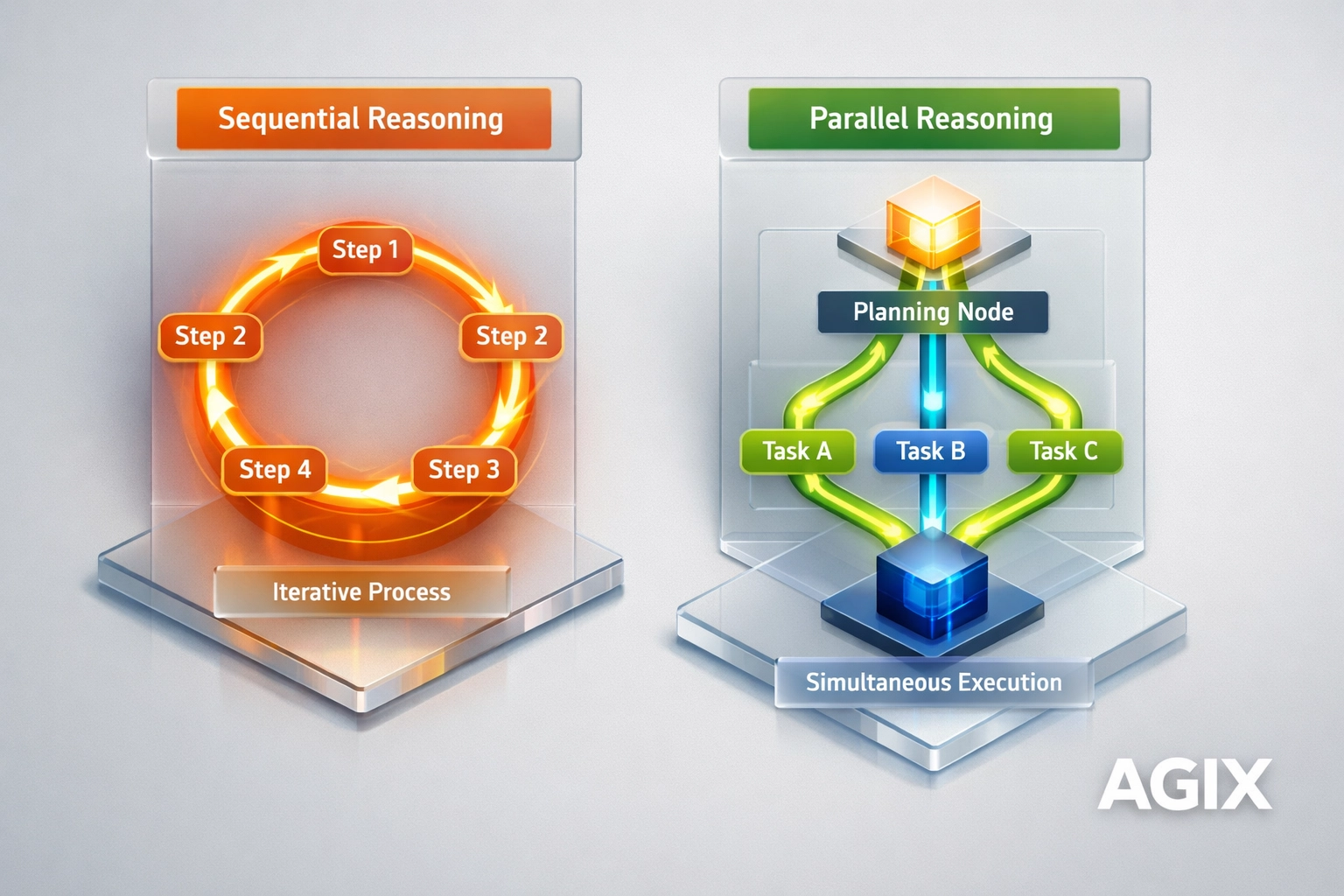
(Technical diagram showing the sequential loop of ReAct vs. the bifurcated planning/execution phase of ReWOO)
Production Implementation: Which One Should You Choose?
Scaling Agentic Intelligence requires a nuanced approach. For a COO looking at ROI, the choice depends on the complexity of the task and the tolerance for latency.
- Use CoT when you need a "sanity check" on internal model logic, such as classifying complex legal documents. (See our Legal AI Comparison).
- Use ReAct for complex troubleshooting or customer support where the model needs to "explore" a problem space dynamically.
- Use ReWOO for standardized operational workflows, like processing an insurance claim or generating a quarterly report where the necessary steps are predictable but require diverse data sources.
Accessing These Patterns: LLM Paths
To implement these patterns, you have three primary paths:
- Consumer LLMs (ChatGPT/Perplexity): These platforms have built-in CoT and some basic ReAct-like capabilities (via GPT-4o tools). However, they offer zero control over the loop architecture, making them unsuitable for specialized enterprise tasks.
- API Integration: Utilizing models like GPT-4o, Claude 3.5 Sonnet, or Gemini 1.5 Pro via API allows you to build custom ReAct and ReWOO loops using frameworks like LangGraph.
- Agix Custom Systems: We build proprietary reasoning engines that optimize these loops for specific industry data, ensuring compliance and data security. Learn more at our Insights Page.
Real-World Systems. Proven Scale.
At Agix Technologies, we don't just talk about patterns; we deploy them. Whether it's optimizing real estate valuations or automating complex fintech workflows, our engineering team ensures that your AI isn't just "smart", it's reliable.
If you are ready to move beyond the experimental phase and build production-grade agentic systems, contact our team today.
FAQs
1. What is the main difference between ReAct and ReWOO?
Ans. ReAct is sequential and iterative (Reason -> Act -> Observe -> Repeat), while ReWOO is plan-based (Reason -> Batch Act -> Final Solve), making ReWOO faster and more cost-effective.
2. Can Chain-of-Thought eliminate hallucinations entirely?
Ans. No, but it significantly reduces them by forcing the model to follow a logical path, making errors much easier to detect during the process.
3. Which LLM is best for ReAct patterns?
Ans. Models with high reasoning capabilities and strong tool-calling performance, such as GPT-4o and Claude 3.5 Sonnet, are currently the industry leaders for ReAct.
4. How does ReWOO save on token costs?
Ans. By eliminating the need for the model to re-process the entire conversation history for every single tool call, ReWOO significantly reduces the total number of tokens sent to the API.
5. Is ReAct suitable for real-time customer support?
Ans. It can be, but latency must be managed. For high-volume support, a hybrid approach or ReWOO is often preferred to keep response times under control.
6. Do I need a specific framework to implement these?
Ans. Frameworks like LangGraph, CrewAI, and Haystack are designed to facilitate these loops, though custom implementations are often required for enterprise-grade security.
7. How do reasoning loops impact AI ROI?
Ans. They increase the reliability of the system. A system that works 99% of the time provides massive ROI, whereas a system that works 70% of the time often costs more in human oversight than it saves.
8. Can these patterns be used with open-source models?
Ans. Yes, models like Llama 3 can be fine-tuned to excel at CoT and ReAct, though they generally require more prompt engineering than flagship proprietary models.
9. What is "System 2 Thinking" in AI?
Ans. It refers to the model taking a slow, deliberate, and logical approach to a problem (like CoT), as opposed to "System 1" which is fast, intuitive, and prone to errors.
10. How do I start migrating from simple prompts to reasoning loops?
Ans. Start by identifying your highest-error tasks. Implement CoT first, then evaluate if the model needs external tools (ReAct) or a pre-planned execution strategy (ReWOO).