White-Label vs Custom Laundry App Development: Key Differences
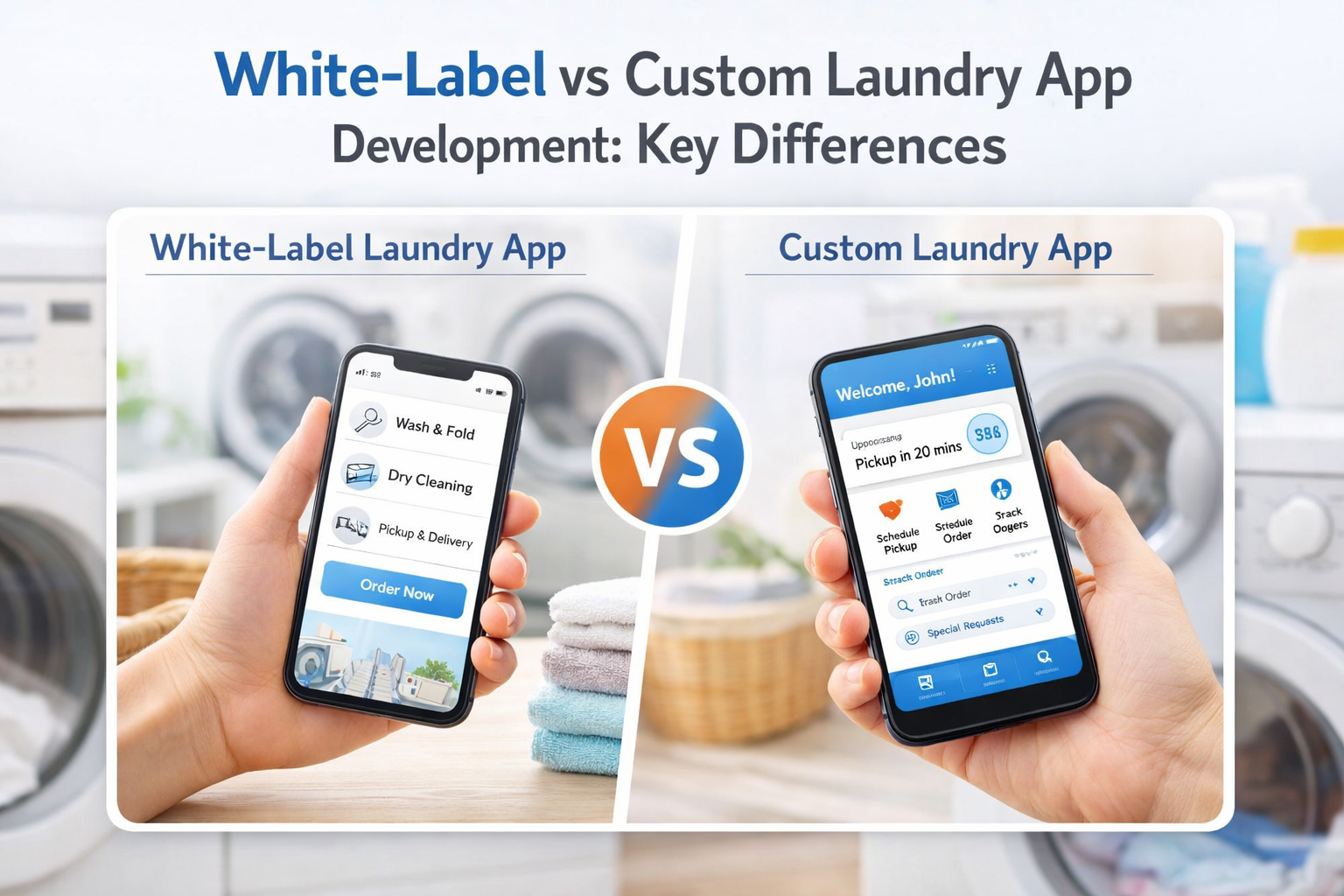
The laundry and dry-cleaning industry has evolved from neighborhood storefronts to tech-enabled service platforms offering doorstep pickup and delivery. Customers now expect real-time order tracking, digital payments, subscription plans and instant notifications. For entrepreneurs and established laundry businesses alike, investing in laundry delivery app development is no longer optional it is a strategic move to stay competitive.
When planning a digital product for your laundry business, the first major decision is whether to choose a white-label solution or build a fully custom app. Both approaches can support on-demand laundry service apps, but they differ significantly in flexibility, cost, scalability and long-term growth potential.
Understanding these differences helps you align your technology investment with your business goals.
Understanding White-Label Laundry App Development
White-label solutions are pre-built applications developed by a software company and resold to multiple laundry businesses under their respective brand names. The core architecture, features and framework remain the same across clients, with limited customization options such as logo, brand colors and pricing configurations.
For startups entering the laundry delivery market quickly, white-label laundry delivery app development may appear attractive. It reduces technical complexity and allows business owners to launch operations in weeks rather than months.
These solutions typically include:
-
Customer mobile app (iOS and Android)
-
Delivery partner app
-
Admin dashboard
-
Order management system
-
Basic analytics and reporting
The vendor handles maintenance, updates and hosting in most cases. Businesses pay a one-time licensing fee or a recurring subscription.
However, since the product is pre-built, structural modifications are often restricted. Advanced integrations, unique workflows, or specialized features such as AI-driven pricing, custom subscription models, or franchise-level management systems may not be feasible without additional costs or limitations.
White-label platforms work best for small businesses testing market demand or operating within a limited geographic region.
What Is Custom Laundry App Development?
Custom development involves building an application from scratch or from a flexible framework tailored specifically to your business model. This approach gives you full control over features, architecture, UI/UX, integrations and scalability.
In custom laundry delivery app development, every component from order flow to pricing logic is designed according to your operational structure. Whether you run a single laundry store, a multi-city franchise, or a marketplace connecting multiple vendors, the platform is built around your needs.
Custom apps often include:
-
Advanced user experience design
-
Flexible order scheduling and routing systems
-
Real-time GPS tracking
-
Dynamic pricing models
-
Loyalty programs and subscriptions
-
Multi-store or multi-vendor management
-
Integration with ERP, CRM and accounting tools
This approach aligns closely with businesses seeking a customized on-demand app development service that reflects their brand identity and long-terzedm expansion plans.
Although custom development requires higher upfront investment and a longer app development timeline, it offers long-term strategic advantages in performance, ownership and differentiation.
Key Differences Between White-Label and Custom Laundry App Development
1. Development Cost and Investment Structure
White-label solutions require lower initial investment. Since the product is already developed, you primarily pay for licensing, branding adjustments and deployment. This makes it appealing for early-stage businesses or entrepreneurs with limited capital.
Custom development, on the other hand, involves UI/UX design, backend development, mobile app coding, testing and deployment. While the initial cost is higher, you own the product entirely. There are no recurring licensing dependencies, which can reduce long-term expenses as your business scales.
From a strategic standpoint, white-label minimizes short-term risk, while custom development maximizes long-term control.
2. App Development Timeline
Speed is one of the strongest advantages of white-label solutions. Deployment can take a few weeks, depending on customization requirements.
Custom laundry delivery app development typically takes three to six months, depending on complexity. If you plan to develop MVP delivery app versions first, the timeline can be shortened to validate your idea before full-scale implementation.
Businesses that prioritize rapid market entry may choose white-label initially, whereas brands aiming for robust infrastructure often invest in custom development from the beginning.
3. Customization and Feature Flexibility
White-label platforms offer limited flexibility. You can modify branding elements and basic configurations, but the core structure remains fixed.
Custom apps provide full design and functionality freedom. If your laundry business requires:
-
Complex pickup and delivery app development features
-
Unique scheduling workflows
-
Hyperlocal logistics optimization
-
Subscription bundles for corporate clients
-
AI-based garment recognition
Custom development is the better choice.
Flexibility becomes critical as customer expectations grow and competition intensifies.
4. Scalability and Long-Term Growth
Scalability determines how well your app can handle increased users, cities and service complexity.
White-label systems may struggle when expanding into multi-city or franchise operations. Since multiple businesses share similar infrastructure, scaling options are limited by vendor architecture.
Custom platforms are built with scalability in mind. Cloud-native architecture, modular backend design and API integrations allow smooth expansion across regions and business models.
For businesses planning aggressive expansion, custom laundry delivery app development supports sustainable growth.
5. Branding and Market Differentiation
Brand identity matters in competitive markets. A white-label app may look similar to other laundry apps using the same vendor solution. While customers may not immediately notice, advanced users often recognize interface similarities.
Custom apps allow unique UI/UX design tailored to your brand personality. From micro-interactions to personalized customer dashboards, every touchpoint reinforces brand recognition.
Businesses focused on premium positioning, niche services, or differentiated offerings benefit more from custom platforms.
6. Ownership and Data Control
Data ownership plays a significant role in digital strategy. In white-label solutions, data storage and management may partially depend on the vendor’s infrastructure.
With custom development, you control your servers, analytics systems and user data. This allows advanced data-driven decision-making, predictive analysis and personalized marketing campaigns.
Data flexibility becomes essential for businesses leveraging AI insights and customer behavior analytics.
When to Choose White-Label Laundry App Development
White-label solutions may be ideal if:
-
You are launching a small laundry startup.
-
You want to test market demand quickly.
-
Budget constraints limit large investments.
-
Your operations are limited to one city.
-
You do not require complex customization.
For early-stage validation, this approach reduces technical barriers and simplifies deployment.
When to Choose Custom Laundry App Development
Custom development is suitable if:
-
You aim to scale to multiple cities or regions.
-
You plan to operate a franchise or multi-vendor marketplace.
-
You require specialized workflows.
-
Long-term brand positioning is important.
-
You want full technical ownership and flexibility.
Companies seeking a strategic technology partner rather than just a software vendor often prefer custom solutions.
Hybrid Approach: Start Small, Scale Smart
Some businesses begin with a minimal version and gradually expand. Instead of full-scale development immediately, they develop MVP delivery app versions to validate user behavior and operational processes.
After gaining traction, the system evolves into a fully custom platform.
This staged approach balances cost efficiency with scalability and reduces risk during early market entry.
Cost Comparison Overview
While exact pricing depends on feature complexity and region, a general comparison looks like this:
White-label solution:
-
Lower upfront cost
-
Monthly subscription or licensing
-
Limited customization
-
Faster deployment
Custom solution:
-
Higher initial investment
-
No licensing dependency
-
Full customization
-
Long-term scalability
Choosing between the two depends on whether your priority is speed or strategic growth.
The Strategic Impact on Laundry Businesses
Technology is no longer just an operational tool. It influences customer experience, operational efficiency and brand perception.
A well-planned laundry delivery app development strategy helps:
-
Automate order management
-
Optimize delivery routing
-
Improve customer retention
-
Increase repeat bookings
-
Enable subscription-based revenue models
Businesses investing in thoughtful architecture and scalable design gain competitive advantages that go beyond convenience.
Conclusion
Choosing between white-label and custom laundry app development depends on your business vision, growth strategy and operational complexity. White-label solutions offer quick deployment and lower entry costs, making them suitable for startups testing the market. Custom development, while requiring higher investment and longer timelines, provides scalability, flexibility and strong brand differentiation.
Businesses planning long-term expansion, advanced logistics integration and high-performance digital ecosystems benefit more from custom solutions. Those prioritizing speed and minimal upfront cost may start with white-label and evolve later.
The right decision aligns technology with your operational goals, ensuring your laundry service remains competitive in a digitally driven marketplace.
FAQs
What is the main difference between white-label and custom laundry app development?
White-label apps are pre-built and rebranded solutions with limited customization, while custom apps are developed from scratch according to specific business requirements.
Is white-label laundry delivery app development cheaper?
Yes, white-label solutions generally require lower initial investment. However, long-term scalability and licensing fees should be considered.
How long does custom laundry app development take?
Depending on complexity, it typically takes three to six months. MVP versions can reduce the timeline.
Which option is better for scaling to multiple cities?
Custom development is more suitable for multi-city expansion and franchise-based models.
Can I switch from white-label to custom later?
Yes, many businesses begin with white-label and transition to custom platforms once revenue and market validation increase.

 English
 Arabic
 French
 Spanish
 Portuguese
 Deutsch
 Turkish
 Dutch
Dutch
 Italiano
 Russian
 Romaian
 Greek
Greek