


The Invisible Pack: What the AQI Cigarette Calculator is Really Telling You
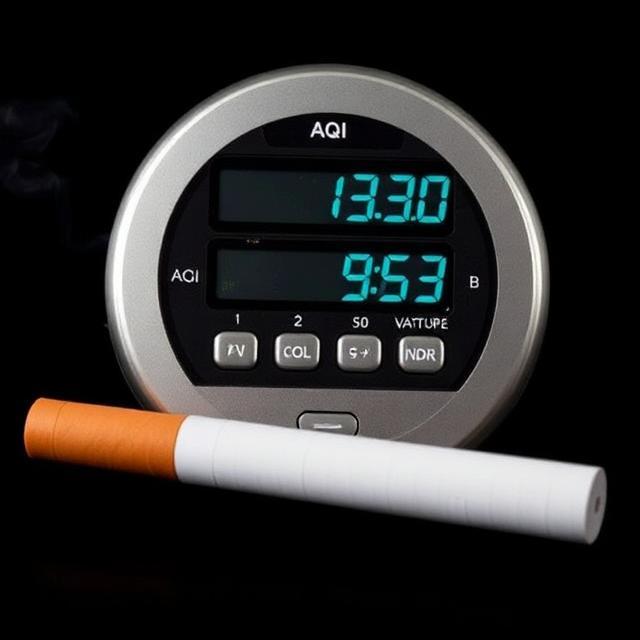
Let’s start with a question that might feel a bit silly. How many cigarettes did you smoke this morning?
If you’re not a smoker, you’re thinking, “None, obviously.” But what if I told you that just by walking to your car, or sitting by an open window, you might have done something strangely similar to smoking? Not with your hands, but with your lungs.
That’s the unsettling magic of an idea called the AQI Cigarette Calculator. It’s not a real gadget. You can’t buy it. It’s a way of seeing the world. A translator for your brain. It takes a fuzzy, scientific warning—“air quality is poor”—and turns it into a sentence that lands with a thud: “Today’s air is like smoking X cigarettes.”
We all get cigarettes. We know they’re bad. That lesson is deep in our bones. The AQI Cigarette Calculator cleverly borrows that deep-down, gut-level fear and uses it to make us afraid of something we usually ignore: the invisible air we breathe.
This article is a friendly, straightforward walk through that idea. We’ll talk in plain words, like we’re figuring it out together. We’ll explore how this AQI Cigarette Calculator works, why this comparison is so effective it almost feels like a trick, and most importantly, what you can actually do with this knowledge. Because information that only makes you anxious is useless. The goal is to turn that shock into calm, smart action.
Let’s start by looking at what’s really in the “nothing” we breathe.
Your Air is Not Just Empty Space
We think of air as… well, as air. Empty space. The stuff between you and the wall. But that’s not quite right. It’s more helpful to picture the air around you as a very, very thin soup. A clear broth. And like any broth, it has ingredients floating in it. Good ingredients, like the oxygen that keeps you alive. And other ingredients.
The AQI Cigarette Calculator is obsessed with one specific type of ingredient in this soup. Scientists call it PM2.5. Let’s break that down. “PM” stands for “Particulate Matter.” That’s fancy talk for “tiny bits of solid or liquid stuff.” The “2.5” is a size. It means these bits are 2.5 micrometers across. To give you a sense of scale, a single strand of your hair is about 70 micrometers wide. So we’re talking about specks that are roughly 30 times smaller than a hair. Completely invisible.
Now, these aren’t harmless little specks of flour. They’re a toxic cocktail. Think of the black smoke from a bus, the eerie orange haze from a wildfire a thousand miles away, the invisible plume from a factory chimney, the dust from a torn-down building. All of this can break apart into these microscopic fragments and just… hang there. For days. Sometimes for weeks.
Here’s the crucial thing about their size: your body is a fantastic fortress against big invaders. Your nose hairs catch pollen. You sneeze out a piece of dust. But PM2.5? It’s like a spy with perfect papers. It walks right past every security guard your body has. You breathe it in, and it travels on a one-way trip to the deepest, tiniest sacs in your lungs. This is where the magic happens—where oxygen jumps into your blood. And because these particles are so unbelievably small, they don’t stop for a visit. They can pass right through the lung’s delicate wall and hitch a ride in your bloodstream. They can end up in your heart, your brain, your kidneys—wherever your blood flows.
So, before we even get to cigarettes, the first thing the AQI Cigarette Calculator forces us to understand is this: the air is not empty. It’s a carrier. On a clear, windy day at the ocean, the carrier might be almost empty. On a still, hazy day in a city or during fire season, that carrier is packed. Every single breath pulls in millions of these invisible hitchhikers. Recognizing this invisible reality is the absolutely essential first step to making sense of the whole, shocking idea.
The Simple Math of Breathing Smokes
Alright. So the air-soup has invisible, harmful stuff in it. The big, weird question is: how do you turn “invisible stuff” into a number of cigarettes? This is where the AQI Cigarette Calculator gets practical. It’s built on a few pieces of simple, startling arithmetic. Let’s break it down like we’re doing easy kitchen math, step by step.
First, scientists needed a basic unit of harm. They asked: “Okay, how much of this PM2.5 gunk does smoking one cigarette actually leave in a person’s lungs?” They studied it and landed on a rough average. The research suggests that after the smoke is exhaled, about 22 micrograms of PM2.5 gets lodged deep in the lung tissue. (A microgram is one-millionth of a gram—an almost silly-small weight). So, let’s establish our unit: One cigarette = 22 micrograms of retained PM2.5.
Second, we need to measure the soup. All over the world, little machines on rooftops act like chefs constantly tasting the broth. They tell us how many micrograms of PM2.5 are in one “cubic meter” of air. (Picture a box as big as a large kitchen oven). Let’s say on a particularly smoggy day in a city, the machine reads 100 µg/m³. That means in that oven-sized box of air, there are 100 micrograms of these invisible particles floating around.
Third, we figure out how much soup you “drink.” An average adult, just sitting at a desk or watching TV, breathes in about 12 cubic meters of air over a full 24-hour day. (This is a key point: if you’re exercising, running for a bus, or mowing the lawn, you breathe much more air—and thus more pollution—per minute. This will become very important.)
Now, the AQI Cigarette Calculator does its translation magic:
-
Pollution concentration: 100 micrograms per cubic meter.
-
Air volume breathed daily: 12 cubic meters.
-
Total pollution inhaled: 100 x 12 = 1,200 micrograms of PM2.5 for the day.
Finally, the big reveal: 1,200 µg (your daily dose) ÷ 22 µg (one cigarette’s worth) = roughly 54.5.
And there it is. The number that makes your eyebrows go up. Breathing that city air, all day long while doing normal, resting things, is roughly equivalent to smoking about five and a half cigarettes.
Please remember: this number from the AQI Cigarette Calculator isn’t a perfect medical fact for you, specifically. It’s a translation tool. A rough equivalence. It takes a hard-to-feel number from a weather app (“PM2.5: 100”) and turns it into a concrete, gut-punch of an image you can instantly understand. It’s a brilliant shortcut for your brain to grasp the scale of an invisible problem. It answers the question, “How bad is ‘bad’?” in the most personal way possible.
Why This Analogy Gets Under Your Skin
Think about your own reactions for a moment. You see a scrolling news ticker that says “Air Quality Advisory in Effect” and you probably just keep eating your toast. But if your neighbor leans over the fence and says, “Heard on the radio it’s like smoking two cigarettes just breathing out there today,” you feel a real, immediate pinch of concern. Why? Why does the AQI Cigarette Calculator analogy stick when official warnings often just slide right off?
It works because it’s deeply personal and it feels fundamentally unfair. In our collective mind, smoking is a choice. A difficult, addictive choice, but a personal one. You buy the pack. You light it. Breathing is not a choice. It’s the most basic requirement for being alive. You have to do it, every few seconds, from birth until death. When you link these two acts, it creates a powerful sense of violation. The air—something that should be safe, free, and neutral—gets instantly reframed as an active, threatening agent. You didn’t sign up for this. Your child playing in the yard didn’t sign up for this. That feeling of injustice is a potent catalyst for awareness. It masterfully shifts pollution from a global “environmental issue” to a personal “bodily invasion.”
It also works because it’s a mental hijack. It uses a shortcut that’s already been paved, lit with neon, and heavily trafficked for over half a century. Public health anti-smoking campaigns have built a superhighway in our brains. That highway leads straight from the word “CIGARETTES” to giant, flashing billboards that say “CANCER,” “HEART DISEASE,” and “DANGER.” The genius of the AQI Cigarette Calculator is that it doesn’t have to build a brand new road from scratch to make us fear PM2.5. Its work is much simpler and more clever. It just constructs a small, sturdy bridge from the “Bad Air” signpost directly onto that existing, well-traveled highway of fear. Our brains zoom across that bridge without a second thought, bringing all the associated dread and understanding with them. It’s borrowed fear, and it works with devastating efficiency.
Finally, it’s perfectly, powerfully shareable. You’re not going to text your friend, “Hey, the 24-hour mean concentration of fine particulate matter has exceeded WHO guidelines!” But you will absolutely send a message saying, “Skip the run today, the air is like three smokes.” In five words, you’ve communicated severity, urgency, and a recommended action. The AQI Cigarette Calculator gives us a folk language for a complex scientific problem. It moves the conversation from the expert’s journal article to the family group chat, and that’s why it’s so sticky. It makes the abstract uncomfortably, undeniably tangible.
The Crucial Limits of the Calculator
Okay, time for a deep breath and a dose of nuance. The AQI Cigarette Calculator is a brilliant spotlight, but it doesn’t illuminate the entire room. It’s a metaphor, and like all metaphors, it has its limits. To use this tool wisely—and not be misled or unduly terrified by it—you need to know where its edges are.
First and foremost, let’s be crystal clear: cigarette smoke and polluted air are not identical twins. They’re more like cousins who cause similar family problems but have different personalities. Cigarette smoke is a complex, nasty cocktail. PM2.5 is a major ingredient, but the cocktail also contains nicotine (which is addictive and hardens arteries), tar (a thick, sticky carcinogen), and carbon monoxide. Outdoor air pollution has a different recipe. It might have higher levels of ground-level ozone (which acts like a sunburn on lung tissue), sulfur dioxide, different heavy metals, or industrial chemicals. So, while the end damage—systemic inflammation, cardiovascular strain, lung tissue damage—is horrifyingly similar, the pathways and the full mix of toxins are not 100% the same.
Second, the calculation is a helpful average, not a precise personal reading. That “22 micrograms per cigarette” figure is based on population research, but it’s a generalization. More importantly, the standard model assumes you’re breathing calmly, at rest, for 24 hours straight. Real life is messier! If you spend an hour gardening, biking, or even walking briskly with groceries, you’re inhaling more air—and thus more pollution—per minute. Your personal “cigarette count” for that specific activity spikes. The AQI Cigarette Calculator gives you a useful, big-picture snapshot of environmental conditions, not a minute-by-minute medical report for your unique body and daily routine.
The biggest limit is the risk of serious misunderstanding. A smoker might think, “Well, I smoke a pack a day. What’s another four from the air?” This is dangerously wrong. The harms are additive. They pile on top of each other. It’s extra damage, not a substitute. It’s like adding more weight to an already overloaded backpack—the straps are more likely to break. Conversely, a health-conscious person might become so anxious they’re afraid to let their children go outside at all. The goal of the AQI Cigarette Calculator is empowerment through awareness, not paralysis through fear. Knowing these limits allows you to hold this tool lightly—using it for the shocking insight and motivation it provides, without mistaking the flashlight’s beam for the entire landscape.
From a Number to Simple, Smart Action
So, you’ve run the AQI Cigarette Calculator in your head. You’ve got a number. The initial feeling can be one of helplessness: “Wow. That’s terrible. I guess I’ll just… accept it?” Let’s flip that script right now. Let’s turn that startling awareness into simple, practical action. You don’t need to live in a hermetically sealed dome. You just need to become a smarter, more informed navigator of your own environment. The AQI Cigarette Calculator is your compass.
Step one is the easiest and most transformative: Become a student of your own sky. Download a free, reliable AQI app like AirVisual or IQAir. Make glancing at it part of your morning routine, right next to checking the weather. Don’t just register “Yellow” or “Red.” Look for the specific PM2.5 number. Let your brain do the quick translation. This simple act, all by itself, changes behavior. On a “high-cigarette” day, you might naturally choose the indoor yoga video over the jog in the park. You might decide to run your errands in the evening instead of the afternoon if the air is forecast to improve. It’s not about living in fear; it’s about intelligent, informed timing based on your AQI Cigarette Calculator insight.
Step two is your most powerful and personal move: Create a clean air sanctuary. For almost everyone, the best place for this is your bedroom. You spend 6-9 hours there every single night. Investing in a good quality HEPA air purifier for your bedroom is the single most effective step to dramatically slash your overall exposure. It gives your body a long, guaranteed break each night to rest, recover, and repair in clean air. On bad air days, keep the windows closed and let it run. Don’t think of it as just another small appliance. Think of it as essential health equipment, as important as a quality mattress or a filter for your drinking water.
And don’t forget the humble mask. A well-fitting N95 or KN95 mask is a direct physical barrier. On a severely polluted day—a “pack-a-day” kind of air event—wearing one during your commute or dog walk is like putting up a shield. It dramatically cuts the dose you take in during that high-exposure period. Finally, use the language the AQI Cigarette Calculator gives you. Talk to your child’s school administrator: “I saw the AQI calculator shows the air at recess is like 2-3 cigarettes for the kids. Do we have an indoor activity plan for days like this?” This framing makes an abstract risk feel concrete, urgent, and actionable for everyone involved.
Your Lungs are a Canary in the Coal Mine
The AQI Cigarette Calculator feels intensely personal—and it is. But your personal “daily score” is like a single, urgent text message from a much larger, interconnected system. Every “cigarette equivalent” is a footprint. It points backward, to its source. And if we have the courage to follow that trail, it leads us far beyond our own lungs, to the health of our communities, our economies, and our planet.
Where does PM2.5 come from? It pours from the tailpipe of the car idling in traffic. It billows from the smokestacks of power plants burning fossil fuels to heat and cool our homes. It rises from industrial factories and from the choking, apocalyptic skies of wildfires, which are becoming bigger, hotter, and more frequent due to a changing climate. Your personal number from the AQI Cigarette Calculator is, in a way, a receipt. A receipt for how we fuel our society, move around our cities, and manage our natural resources.
This realization transforms the calculator from a mere personal health tool into a potent civic tool. It connects the vague, often politicized concept of “emissions reductions” directly to the tangible tightness you might feel in your own chest on a bad air day. It makes terms like “urban planning,” “renewable energy mandates,” and “climate policy” suddenly feel urgent, personal, and immediate. When you see the air through the lens of the AQI Cigarette Calculator, you understand that buying an air purifier is a necessary and smart personal response, but advocating for cleaner public transit, supporting renewable energy projects, and demanding stricter industrial regulations are the essential collective cure.
Let this awareness fuel a quieter, steadier, more determined kind of action. Support local policies for electric school buses and protected bike lanes. Vote with air quality and climate in mind. Talk about the AQI Cigarette Calculator not to spread panic, but to spread a new, visceral understanding—to make the invisible, visible for your friends, family, and neighbors. The ultimate, hopeful goal is to make this calculator obsolete. To reach a future where the daily “cigarette equivalent” is so close to zero it becomes a forgotten historical curiosity. That better future starts the moment enough of us look at the haze and, for the very first time, truly comprehend what we’re all breathing in—and decide we deserve better.
Conclusion
The AQI Cigarette Calculator is a gift of brutal, necessary clarity. In a world drowning in complex data and far-off warnings, it offers a simple, shocking translation. It takes an invisible, slow-motion public health crisis and hands it to you in a form you can instantly comprehend—a number of cigarettes you never chose to smoke, but are breathing in anyway, day after day.
This knowledge is not a life sentence to anxiety. It is a key. It unlocks the power to see your everyday environment for what it truly is. The power to make smarter choices, from the small (which window to open and when) to the significant (where to live, how to vote, what to advocate for). It gives you the words—simple, powerful words—to talk about clean air in a way that finally makes people stop, listen, and feel what’s at stake.
So start simple. Just look up your AQI today. Notice it. Think about the air in the room where you sleep. One clean breath of understanding leads to another. The long journey to healthier air for everyone begins with a single, shocking realization. It begins the moment we all learn to count the invisible pack. Now that you can see it, you hold the power to start putting it down for good.
Questions and Answers
Q: I’m a smoker. Does that mean air pollution isn’t as big a deal for me?
A: This is the most critical point to understand. The effects are additive, meaning they stack on top of each other. If you smoke 15 cigarettes a day and the air adds a “4-cigarette equivalent,” your body is dealing with the combined assault of 19 units of particulate harm. Smoking already stresses your heart and lungs, making them more vulnerable to the added insult of pollution, not less. The AQI Cigarette Calculator should be an extra, powerful reason for a smoker to care about clean air, not an excuse to dismiss it.
Q: Are the health impacts from pollution and cigarettes exactly the same?
A: They are tragically similar in their major outcomes, but the “recipes” are different. Both significantly increase the risk of heart disease, stroke, lung cancer, and chronic lung diseases like emphysema. Both cause widespread inflammation in the body. The key difference is the additional, unique toxins in cigarette smoke, like nicotine and tar. The AQI Cigarette Calculator focuses on the common, primary villain—PM2.5—to provide a stark, relatable measure of comparable harm.

 English
 Arabic
 French
 Spanish
 Portuguese
 Deutsch
 Dutch
Dutch
 Italiano
 Russian
 Romaian
 Portuguese (Brazil)
 Greek
Greek