


How BI Integration Boosts ERP and CRM Efficiency for Better Data Use
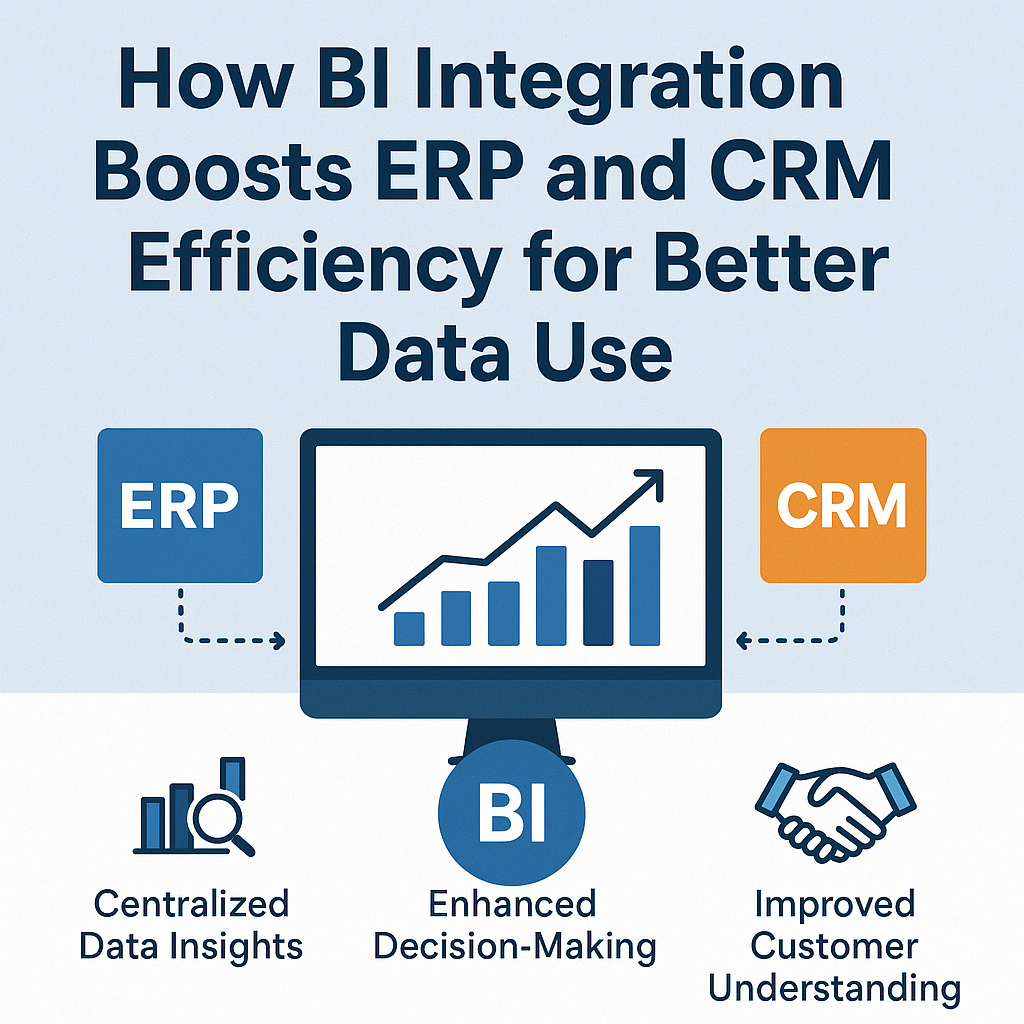
In today’s digital era, businesses rely heavily on ERP (Enterprise Resource Planning) and CRM (Customer Relationship Management) systems to streamline operations and manage customer relationships. However, these platforms often generate massive amounts of raw data that can be hard to analyze and apply effectively. This is where Business Intelligence (BI) integration comes in, turning complex data into actionable insights.
Read More: How BI Integration Boosts ERP and CRM Efficiency for Better Data Use
Why ERP and CRM Alone Aren’t Enough
ERP systems handle everything from finance and supply chain to human resources, while CRM platforms track customer interactions, sales, and service. Despite their capabilities, these tools often leave decision-makers overwhelmed with scattered data. Without a structured way to analyze and visualize this information, businesses miss opportunities to optimize processes and enhance customer experiences.
How BI Integration Improves ERP and CRM
Integrating BI tools with ERP and CRM systems bridges the gap between raw data and informed decision-making. Here’s how:
1. Centralized Data Insights
BI gathers data from ERP and CRM systems into a unified dashboard, making it easier for teams to view key metrics at a glance. This saves time and reduces errors compared to switching between multiple reports.
2. Enhanced Decision-Making
With real-time analytics and visualization, managers can quickly identify trends, track performance, and respond to issues. For example, sales teams can spot declining customer engagement early and take corrective action.
3. Improved Customer Understanding
When BI is integrated with CRM, businesses gain deeper insights into customer behavior, preferences, and buying patterns. This allows for more personalized marketing and better customer service strategies.
4. Operational Efficiency
BI integration highlights inefficiencies in ERP processes, such as supply chain delays or inventory mismatches. Companies can then adjust operations to save time, cut costs, and increase productivity.
5. Future-Ready Growth
By combining ERP, CRM, and BI, businesses prepare themselves for scalable growth. Predictive analytics can forecast demand, optimize resources, and guide long-term strategies.
Real-World Example
Imagine a retail company using ERP for inventory and CRM for customer interactions. By integrating BI, the company can:
-
Track which products sell fastest in real time.
-
Identify regional demand patterns.
-
Personalize promotions for loyal customers.
This leads to better inventory planning, stronger customer relationships, and higher revenue.
Visit Here: https://shorturl.at/QjbNm
Conclusion
BI integration is the key to unlocking the full potential of ERP and CRM systems. It transforms scattered data into valuable insights, empowering businesses to make smarter decisions, streamline operations, and deliver superior customer experiences. Companies that adopt BI alongside ERP and CRM not only gain efficiency but also a competitive edge in today’s data-driven world.

 English
 Arabic
 French
 Spanish
 Portuguese
 Deutsch
 Dutch
Dutch
 Italiano
 Russian
 Romaian
 Portuguese (Brazil)
 Greek
Greek