


The Complete Guide to Outsourcing Revit Family Creation
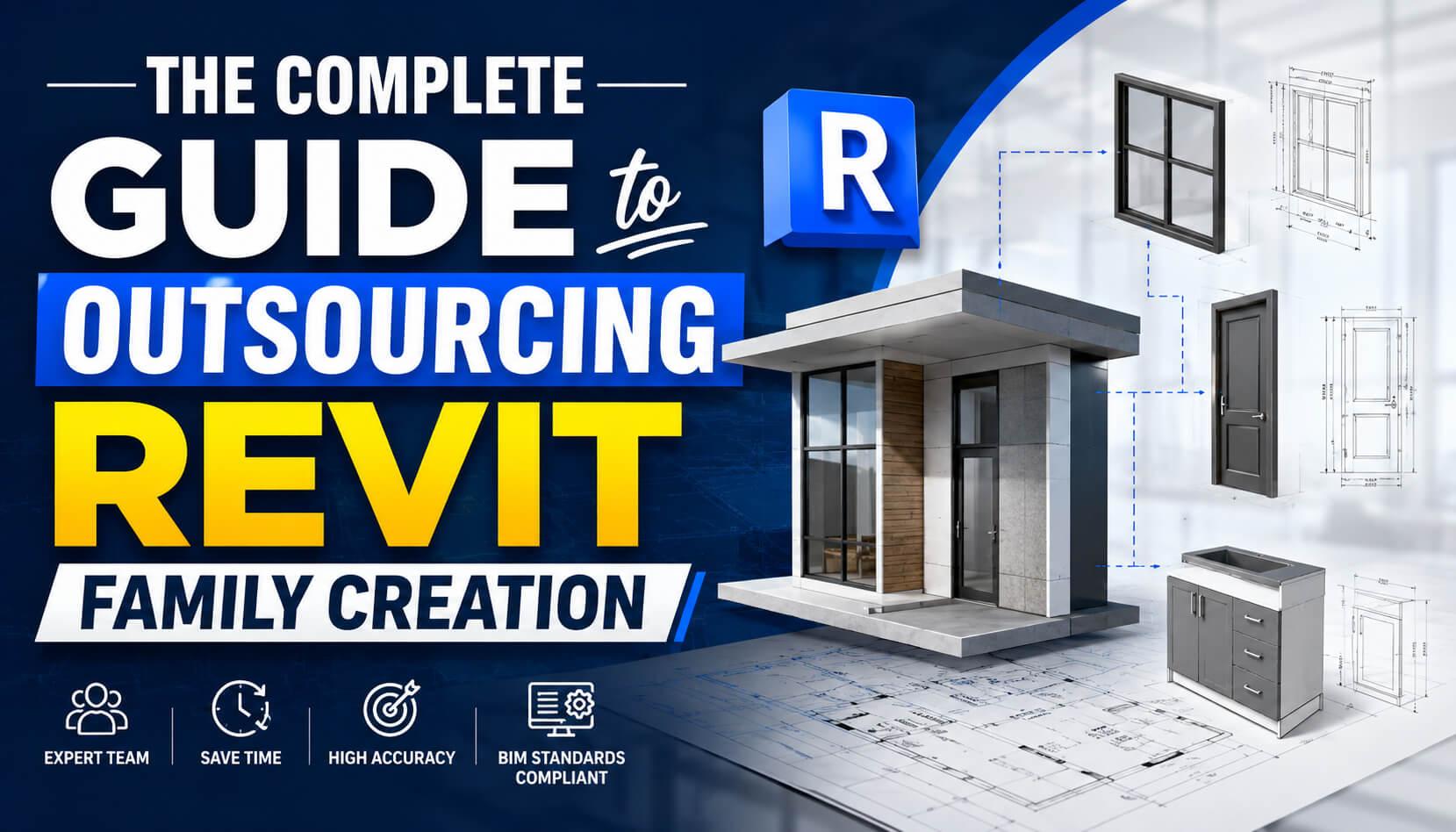
Outsourcing Revit family creation helps architecture, engineering, and construction firms reduce costs, access specialized expertise, and speed up BIM workflows. This guide covers everything you need to know—from choosing the right partner to managing the process effectively.
Revit families are the foundation of any Building Information Modeling (BIM) workflow. Get them right, and your entire project benefits—from design coordination to construction documentation. Get them wrong, and you're looking at costly rework, compatibility issues, and project delays.
For many firms, creating high-quality Revit families in-house is a significant resource drain. It requires specialized skills, dedicated time, and constant updates to keep pace with manufacturer specifications and BIM standards. That's why a growing number of AEC professionals are choosing to outsource Revit family creation services, freeing up their teams to focus on what they do best.
This guide breaks down everything you need to know: what Revit families are, why outsourcing makes sense, how to choose the right partner, and how to manage the process for consistently great results.
What Are Revit Families, and Why Do They Matter in BIM?
Revit families are parametric components within Autodesk Revit that represent real-world building elements—doors, windows, furniture, structural components, MEP equipment, and more. Each family contains geometry, data parameters, and behavioral logic that allows it to respond intelligently to design changes.
There are three main types:
- System families (walls, floors, roofs)
- Loadable families (custom components like fixtures or furniture)
- In-place families (unique elements created for a specific project)
Accurate Revit families directly impact model coordination, clash detection, quantity takeoffs, and construction documentation. A poorly built family can corrupt schedules, break view templates, and slow down an entire project team. High-quality families, on the other hand, improve collaboration, reduce errors, and support better downstream decision-making.
Why Outsource Revit Family Creation?
Is outsourcing Revit family creation cost-effective?
Yes—significantly so. Hiring and training in-house BIM specialists is expensive, especially for firms that only need family creation intermittently. Outsourcing Revit family creation converts a fixed staffing cost into a flexible, project-based expense. Firms can scale up or down based on workload without the overhead of full-time salaries, software licenses, and ongoing training.
What expertise do outsourcing providers bring to Revit family creation?
Specialized outsourcing providers focus exclusively on BIM content development. Their teams are experienced across a wide range of family types, manufacturer specifications, and Revit versions. This depth of expertise is difficult to replicate in-house unless BIM content creation is a core part of your business model.
How does outsourcing save time on BIM projects?
Dedicated outsourcing teams can turn around families faster than an in-house team juggling multiple project responsibilities. This speed matters when you're working against tight design deadlines or responding to last-minute specification changes.
How does outsourcing Revit families support core business focus?
Every hour your BIM team spends building parametric components is an hour not spent on design, coordination, or client engagement. Outsourcing removes this distraction, allowing your team to stay focused on higher-value work.
How to Choose the Right Revit Family Outsourcing Partner
Not all outsourcing providers are equal. Choosing the wrong one can result in poor-quality families, missed deadlines, and communication breakdowns. Here's what to look for.
What should you check in an outsourcing provider's portfolio?
Review their existing library of Revit families. Look for consistency, parametric accuracy, naming conventions, and compliance with BIM standards (such as LOD specifications). A strong portfolio signals both technical competence and attention to detail. If possible, request sample families to test before committing to a full engagement—providers like Chudasama Outsourcing make this easy by offering trial projects.
How do outsourcing providers ensure quality control for Revit families?
Ask about their quality assurance process. Reputable providers conduct multi-stage reviews—checking geometry, parameter behavior, file size, and compliance with your firm's BIM standards before delivery. Look for providers that use structured QA checklists and have dedicated review personnel separate from the creation team.
What communication and collaboration tools should you expect?
Effective outsourcing depends on clear, consistent communication. Look for partners who use established project management and communication tools—such as Asana, Trello, or Microsoft Teams—and who assign a dedicated project manager to your account. Regular check-ins and shared progress tracking reduce the risk of misalignment.
How should data security be handled when outsourcing Revit families?
Sharing project files and proprietary design information with a third party carries inherent risk. Before engaging any provider, confirm they have data security protocols in place—including NDAs, secure file transfer methods, and clear policies on data retention and deletion after project completion.
What Does the Revit Family Outsourcing Process Look Like?
A well-run outsourcing engagement typically follows four stages:
1. Define project requirements
Document exactly what you need—family type, LOD, parameters, host behavior, naming conventions, and any specific manufacturer data. The more detail you provide upfront, the fewer revisions you'll need later.
2. Share relevant information
Provide product specifications, manufacturer datasheets, reference imagery, and your firm's BIM standards. If you have existing families as benchmarks, share those too.
3. Review and feedback loops
Establish a clear feedback process from the start. Most providers offer two to three rounds of revisions as standard. Use structured feedback—screenshots with annotations, or marked-up PDFs—rather than vague written descriptions.
4. Delivery and integration
Once approved, families are delivered in agreed formats and integrated into your project library. A good provider will also offer brief documentation on each family's parameters and intended use.
Best Practices for Successful Revit Family Outsourcing
Clear communication from day one
Ambiguity is the enemy of good outsourcing outcomes. Define deliverables, timelines, revision limits, and escalation paths before work begins. A short project brief—even one page—can prevent significant back-and-forth later.
Set realistic expectations
Custom Revit family creation takes time, especially for complex MEP or structural components. Rushing the process increases the risk of errors. Work with your provider to set achievable deadlines that account for review cycles.
Build long-term partnerships
The best outsourcing relationships improve over time. As a provider learns your firm's standards, preferences, and project types, turnaround speeds increase and revision rates drop. Treat your outsourcing partner as an extension of your team, not a one-off vendor.
The Future of Revit Family Creation Is Collaborative
Outsourcing Revit family creation is no longer a workaround—it's a strategic decision that forward-thinking AEC firms are making deliberately. Access to specialized expertise, reduced overhead, and faster turnaround times all contribute to better BIM outcomes and more competitive project delivery.
Looking ahead, the growing adoption of open BIM standards, cloud-based collaboration platforms, and AI-assisted parametric modeling will make outsourced BIM content development even more seamless. Firms that establish strong outsourcing partnerships now will be well-positioned to scale with these changes.
If you're ready to explore how Chudasama Outsourcing can support your next project, start by reviewing their portfolio, requesting a sample family, and outlining your BIM standards. The right partner is out there—and the payoff is worth the effort.
Frequently Asked Questions
What types of Revit families can be outsourced?
Almost any loadable family can be outsourced, including architectural components (doors, windows, furniture), MEP equipment, structural elements, and manufacturer-specific product families.
How much does it cost to outsource Revit family creation?
Costs vary based on complexity, LOD requirements, and provider location. Simple families may cost $20–$80 per family, while complex parametric components can run $150 or more. Volume discounts are common with long-term arrangements.
How long does it take to receive outsourced Revit families?
Simple families typically take one to three business days. Complex families with detailed parametrics may take up to a week. Timelines depend on the provider's workload and the clarity of your brief.
Is it safe to share project files with an outsourcing provider?
Yes, provided the provider has robust data security protocols, including NDAs and secure file transfer systems. Always confirm these policies before sharing sensitive project information.
How do I know if an outsourced Revit family meets quality standards?
Test the family thoroughly in your Revit environment before adding it to your library. Check parameter behavior, hosting compatibility, view representation at different LODs, and file size. A reputable provider will accommodate revision requests if the family doesn't meet agreed specifications.