


How Europe Looted Africa: strategy to liberate Africa!
Caught between climate change, migration and social upheaval, Niger and the Sahel are the crucible of Western failure.
As I detailed in “The Coming Anarchy”, the issue of climate change must be integrated with high population growth in the poorest countries, as well as with resource scarcities, disease spreads, weak or non-existent institutions, illogical borders, and inter-ethnic, sectarian disputes. While Africa is now 18 per cent of the world population, it will rise to 26 per cent by 2050, and is projected to be almost 40 per cent by 2100.

Niger in 2004 with a platoon of US marines a decade after I had published “The Coming Anarchy”. The capital, Niamey, is tucked into the extreme south-west of a country that is largely encompassed by the Sahara Desert. As I headed north and east away from the capital on rutted dirt tracks, it was as if the country disappeared: no police, no signs of authority, nothing.
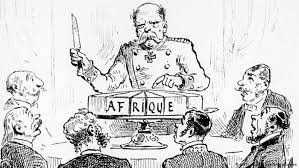
When the French colonialists drew these borders in the 19th and early 20th centuries, they placed the capitals as far to the south and as close to the savannah as they could – partly so that the cities would be merely northward extensions of coastal West Africa where the colonial troops were mostly located. It is the capitals and nearby populations that are properly part of the Sahel, an ecological transition zone between desert and grassland.
 colonial looting Africa
 What is the Demography of Africa?
Consider the borders of the Sahel and West Africa. Whereas demographic logic argues for a horizontality – that is, a unified coastal community along the Gulf of Guinea – you have a political map that slices up this enormous territory vertically, with populations anchored in the south and forced to project power far to the north, which many have trouble doing. This would be a supreme challenge even without the ethnic and other divisions that beset these countries. Then there is the hostility of the Earth itself: tropical soils are not that fertile, and quick growth of crops by no means releases populations from labour. Climate change, in the form of drought and a warming planet.
What is to be done?
The American foreign policy elite, with some notable exceptions, believes it has the best answer: democracy. If West African countries would only hold elections and abide by civilian rule they would gradually get on their feet and build governing institutions throughout their territories. The American elite defines successful countries in the developing world as those that hold elections and unsuccessful ones as those that fail to do so. This is not logic, nor a belief grounded in history or even political science. It is pure ideology. And missionary ideology at that.
Look at the Arab Spring’s failure! Of course, people in the developing world want democracy, but that doesn’t mean it will automatically bring good results in the face of vast poverty, ethnic and sectarian cleavages and so forth. Democracy has worked in places such as South Korea and Taiwan because it came after industrialisation and the creation of middle classes, not before.
 Caught between climate change, migration and social upheaval, Niger and the Sahel are the crucible of Western failure.
 What is the result?
The result is Niger, where an elected president has a falling out with his own guards and a coup results – the existence of an elected president did not mean there was an operational and institutionalized democratic system, or anything close to resembling one. The Biden administration simply assumed too much in Niger. I am not saying that we should meekly accept coups, especially this one, where the junta’s harsh treatment of the deposed president and his family may indicate a particularly brutal streak. But neither should we assume democracy must be the natural, default option in every poor country.
For the moment, the trends are negative.
Niger’s crisis belongs to the West
Taken together, and given the difficulties of imposing democracy, different forms of chaos as well as environmentally driven hard regimes loom ahead. Chaos does not necessarily produce headlines. Daily electricity blackouts and water shortages, combined with the relative absence of police and public order, are forms of low-level chaos that become normalized, or at least accepted, when there is no alternative.


 English
 French
 Spanish
 Portuguese
 Deutsch
 Turkish
 Dutch
Dutch
 Italiano
 Russian
 Romaian
 Portuguese (Brazil)
 Greek
Greek