


Best Shopify Alternatives for Startups and SMEs
Disclosure: This post contains links to products we've researched and used, including some affiliate/partner links.
Starting an online store used to mean choosing between two or three platforms. Today, founders have dozens of options, each with different pricing models, feature sets, and learning curves.
Shopify remains a popular choice. But it's not always the right fit for every budget or business stage.
If you're a startup or small business watching every rupee (or dollar), it's worth knowing what else is out there before you commit.
Why Look Beyond Shopify?
Shopify is solid, but it comes with trade-offs that matter more to smaller businesses than to large enterprises.
Transaction Fees Add Up
Unless you use Shopify Payments, you'll pay extra transaction fees on every sale. For a startup running thin margins, that's real money leaving the business every month.
App Costs Multiply Fast
Shopify's core plan is lean by design. Most stores end up adding several paid apps for SEO, email marketing, reviews, or inventory and those subscriptions stack up quickly.
The Learning Curve Isn't Always Beginner-Friendly
Shopify is built for scale, which means some features (custom theme code, advanced settings) assume a level of technical comfort that not every first-time founder has.
None of this makes Shopify a bad platform. It just means it's worth comparing alternatives before you lock in a long-term commitment.
What to Look for in an Ecommerce Platform
Before comparing specific tools, it helps to know what actually matters for a small team.
-
Total cost of ownership — not just the monthly plan, but hosting, apps, and transaction fees combined
-
Ease of setup — can you launch in days, not weeks?
-
Built-in marketing tools — SEO, email, and discount features without needing five separate apps
-
Scalability — will the platform still work when you 10x your order volume?
-
Support quality — especially important if you don't have an in-house dev team
With that in mind, here's a rundown of platforms worth considering.
Top Shopify Alternatives for Startups and SMEs
1. ShopEasy.ai
ShopEasy.ai is an AI-driven store builder aimed squarely at small teams that don't want to manage a patchwork of plugins. Its atlas ai store builder uses AI to generate product descriptions, suggest layouts, and handle a lot of the initial setup work that usually eats up a founder's first few weeks.
For businesses that want to launch fast without hiring a developer, this kind of automation can meaningfully cut time-to-launch.
It's positioned as a serious option among the best ecommerce website builder choices for SMEs specifically because the core plan bundles SEO tools, email marketing, and inventory management — features that are often paid add-ons elsewhere.
For founders in India weighing local pricing, payment gateway support, and rupee-denominated plans, it's worth looking at how it stacks up against shopify alternatives india businesses are already considering, since regional support can vary a lot between platforms.
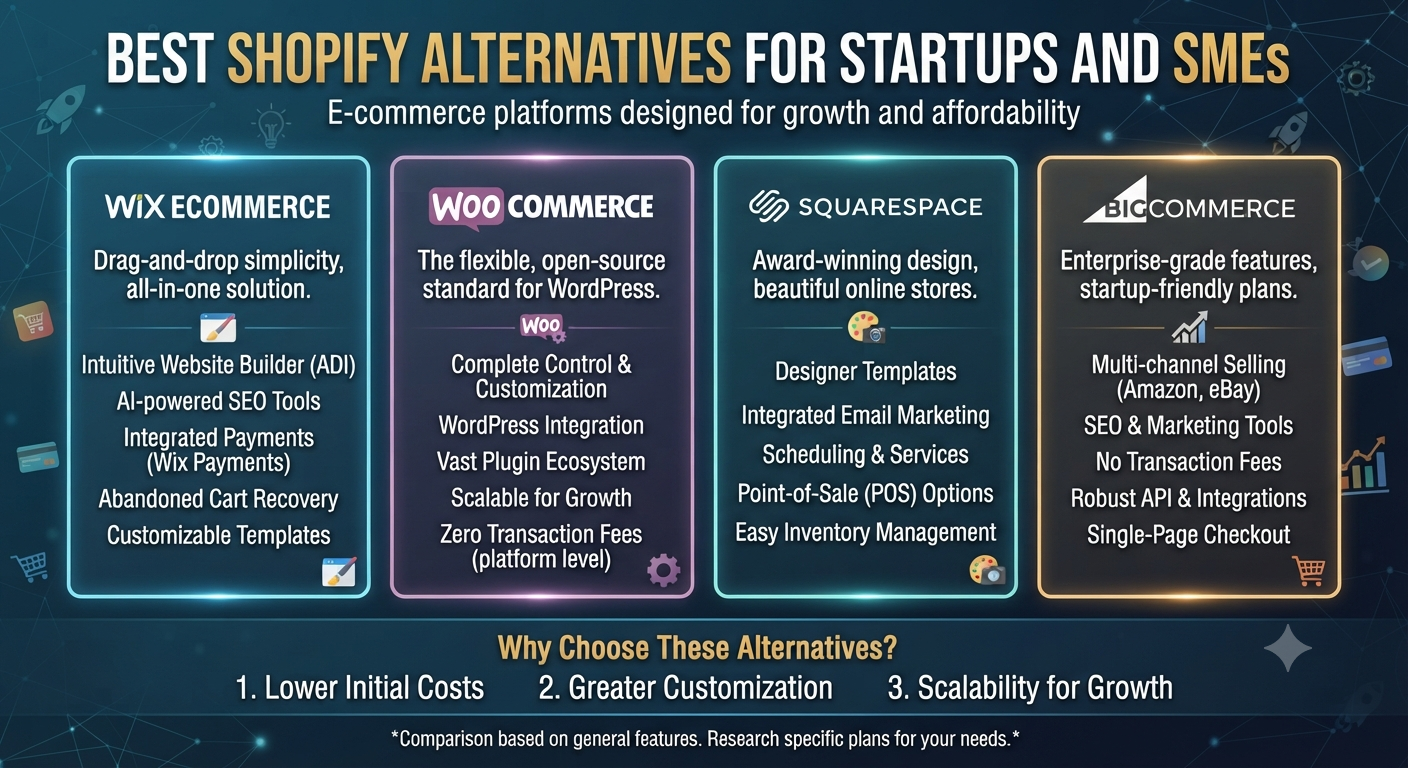
2. WooCommerce
WooCommerce is a free WordPress plugin, which makes it attractive for anyone already comfortable in the WordPress ecosystem.
Pros:
-
No platform fee — you only pay for hosting and any paid extensions
-
Huge plugin library
-
Full content control if you already run a WordPress blog
Cons:
-
You're responsible for hosting, security, and updates
-
Costs can creep up once you add premium extensions
-
Steeper learning curve for non-technical founders
WooCommerce works best for businesses that already have some WordPress experience or a developer on call.
3. BigCommerce
BigCommerce competes directly with Shopify on the mid-market segment. It doesn't charge transaction fees regardless of your payment gateway, which is a meaningful saving over time.
Pros:
-
No transaction fees on any plan
-
Strong built-in SEO and multi-channel selling
-
Good for catalogs with complex product variants
Cons:
-
Pricing tiers are based on annual sales volume, which can get expensive as you grow
-
Themes are fewer and less customizable out of the box than Shopify's
4. Squarespace
Squarespace is known for design-forward templates. It's a strong fit for brands where visual presentation is central think fashion, art, or boutique product lines.
Pros:
-
Beautiful, modern templates with minimal tweaking needed
-
All-in-one pricing, less app dependency
-
Good blogging tools built in
Cons:
-
Ecommerce features are less robust than dedicated platforms
-
Limited third-party app ecosystem compared to Shopify or WooCommerce
5. Wix eCommerce
Wix has matured significantly as an ecommerce option, particularly for very small catalogs.
Pros:
-
Drag-and-drop builder is genuinely beginner-friendly
-
Affordable entry-level plans
-
Decent built-in marketing tools
Cons:
-
Less suited to stores planning rapid growth or large catalogs
-
Switching templates after launch can be restrictive
How to Choose the Right Platform for Your Business
There's no single "best" platform only the best fit for your stage and constraints. A few practical questions to ask yourself:
How technical is your team? If you have no developer, prioritize platforms with strong out-of-the-box features over ones that need heavy customization.
What's your real budget, all-in? Add up subscription, transaction fees, and likely app costs — not just the advertised monthly price.
How fast do you need to launch? AI-assisted builders can shave real time off setup if speed matters more than deep customization right now.
Where are your customers? Regional payment gateway support and local tax compliance can be deciding factors, especially outside the US.
If you're specifically comparing platforms head-to-head, it's worth reviewing a detailed breakdown of the best Shopify alternatives before making a final call feature comparisons tend to reveal trade-offs that marketing pages gloss over.
Final Thoughts
Shopify earned its reputation for good reason, but it's not automatically the right starting point for every startup or SME.
Platforms like WooCommerce, BigCommerce, Squarespace, and Wix each solve for different priorities cost control, design flexibility, or ease of use. Newer AI-driven builders are also worth a look if speed to launch and reduced app dependency matter to your team.
The right move is to map your actual constraints budget, technical skill, timeline against what each platform genuinely offers, rather than defaulting to the most familiar name.
Frequently Asked Questions
1. Is Shopify still worth it for a small business in 2026? Yes, for many businesses it still is particularly those planning rapid scale or needing a huge app ecosystem. But it's worth comparing alternatives first, since smaller businesses sometimes pay for scale-oriented features they don't yet need.
2. What's the cheapest Shopify alternative for a startup? WooCommerce has no platform fee itself, though hosting and extensions add cost over time. Wix and entry-level AI builders also tend to have lower all-in monthly costs for very small catalogs.
3. Are AI store builders reliable for a first-time founder? Generally, yes. AI-assisted builders are designed to reduce the technical burden of setup generating layouts, descriptions, and SEO basics automatically which can be especially useful if you don't have design or dev experience.
4. Do these alternatives support Indian payment gateways and GST compliance? It varies by platform, so this is worth checking directly before committing. Some platforms, including regionally focused options, build in local payment gateway and tax support that global platforms add only through third-party apps.
5. Can I migrate from Shopify to another platform later without losing data?Most established platforms offer product and customer data import tools, though the complexity depends on your catalog size and how much custom code your current store uses. It's smoother to migrate early than after years of accumulated customizations.