


Human-in-the-Loop AI: Designing Systems That Learn with Expert Feedback
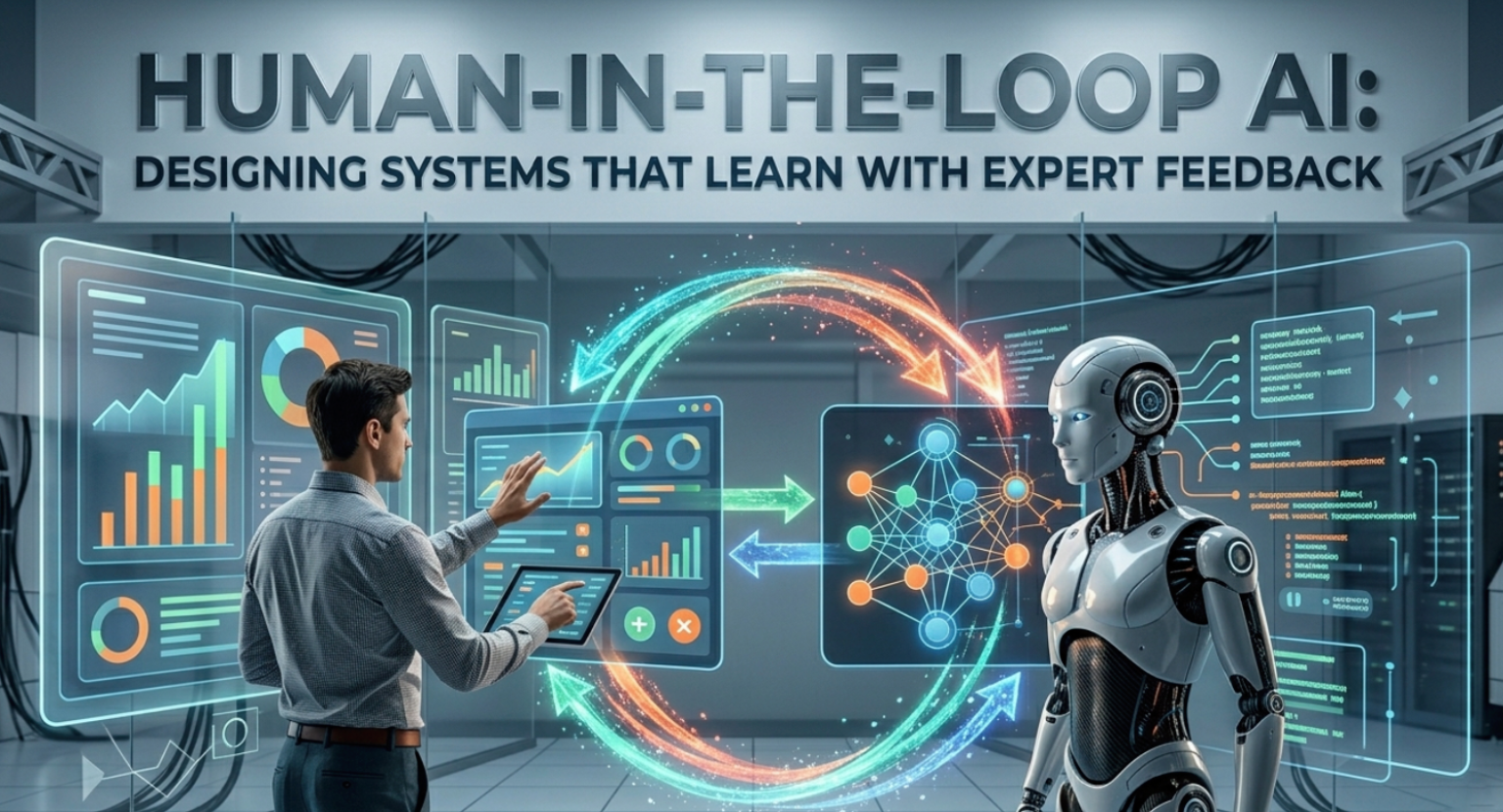
As artificial intelligence continues to transform enterprise operations, organizations are increasingly recognizing that fully autonomous systems are not always the optimal solution especially in high-stakes environments. Instead, a more balanced approach is emerging: Human-in-the-Loop (HITL) AI, where human expertise is integrated directly into the learning and decision-making process.
This approach allows businesses to combine the speed and scalability of AI with the judgment, context, and domain knowledge of human experts. The result is more accurate, reliable, and adaptable AI systems that continuously improve over time.
In this blog, we explore what Human-in-the-Loop AI is, how it works, its benefits and challenges, and how enterprises can design effective systems that learn through expert feedback.
Understanding Human-in-the-Loop AI
Human-in-the-Loop AI refers to a system design approach where human input is incorporated at various stages of the AI lifecycle. Instead of relying solely on automated predictions, the system actively involves humans to:
- Validate outputs
- Correct errors
- Provide contextual insights
- Guide model behavior
These interactions create a feedback loop that helps the AI model learn and improve continuously.
HITL systems are particularly valuable in scenarios where:
- Accuracy is critical
- Data is complex or ambiguous
- Ethical or regulatory oversight is required
How Human-in-the-Loop AI Works
At its core, HITL AI operates through an iterative feedback cycle. The process typically involves:
1. Initial Model Deployment: An AI model is trained using available data and deployed to perform specific tasks.
2. Human Review and Feedback: Experts review the AI’s outputs and provide corrections, annotations, or approvals.
3. Model Refinement: The feedback is incorporated into the training pipeline, improving the model’s performance.
4. Continuous Learning Loop: The system continuously learns from new feedback, adapting to evolving requirements.
This cycle ensures that the AI system becomes more aligned with real-world expectations over time.
Benefits of Human-in-the-Loop AI
Human-in-the-Loop systems offer several advantages for enterprise AI deployments.
Improved Accuracy and Reliability: Human validation helps identify and correct errors that automated systems may miss, leading to more precise outputs.
Faster Adaptation to Changing Conditions: Experts can quickly adjust the system’s behavior by providing feedback, enabling rapid adaptation without full retraining.
Enhanced Trust and Transparency: Involving humans in decision-making builds trust among stakeholders, especially in regulated industries.
Better Handling of Edge Cases: AI models often struggle with rare or ambiguous scenarios. Human intervention ensures these cases are handled appropriately.
Reduced Risk in Critical Applications: Industries such as healthcare, finance, and legal services benefit from human oversight to minimize potential risks.
Limitations of Human-in-the-Loop AI
While HITL offers significant benefits, it also introduces certain challenges.
Increased Operational Cost: Maintaining human reviewers requires time, resources, and skilled personnel.
Scalability Constraints: As the volume of data grows, relying heavily on human input can limit scalability.
Workflow Complexity: Designing efficient feedback loops and integrating them into existing systems can be complex.
Potential for Human Bias: Human feedback can introduce bias if not properly managed and standardized.
Designing Effective HITL Systems
To fully leverage Human-in-the-Loop AI, organizations must design systems that balance automation with human input.
Identify Critical Decision Points: Not every task requires human intervention. Focus on areas where accuracy and judgment are most important.
Define Clear Feedback Mechanisms: Establish structured processes for collecting and incorporating expert feedback.
Use Active Learning Strategies: Prioritize uncertain or high-impact cases for human review, maximizing the value of expert input.
Build Scalable Workflows: Combine automation with selective human involvement to maintain efficiency at scale.
Monitor and Evaluate Performance: Continuously track system performance and refine feedback loops to improve outcomes.
Enterprise Use Cases
Human-in-the-Loop AI is widely used across industries to enhance decision-making and system performance.
Healthcare Diagnostics: AI models assist in analyzing medical images, while doctors validate and refine the results to ensure accuracy.
Financial Risk Assessment: AI systems identify potential fraud or credit risks, with human analysts reviewing high-risk cases.
Content Moderation: Platforms use AI to flag inappropriate content, which is then reviewed by human moderators for final decisions.
Document Processing: AI extracts information from contracts or invoices, while experts verify and correct the outputs.
Customer Support Automation: AI chatbots handle common queries, while complex issues are escalated to human agents.
Future Trends in Human-in-the-Loop AI
As AI technology evolves, new advancements are making HITL systems more efficient and scalable.
Active Learning and Smart Sampling: AI models are becoming better at identifying which data points require human input.
Real-Time Feedback Integration: Systems are increasingly capable of incorporating feedback instantly, improving responsiveness.
AI-Assisted Human Decision Making: Rather than replacing humans, AI is evolving to augment human expertise.
Low-Code AI Platforms: User-friendly tools are enabling non-technical experts to participate in AI training and feedback processes.
Integration with Retrieval-Augmented Systems: Combining HITL with retrieval-based AI systems enhances both accuracy and contextual understanding.
Best Practices for Implementation
To successfully implement Human-in-the-Loop AI, organizations should:
- Start with clearly defined objectives
- Use high-quality, domain-specific data
- Establish standardized review guidelines
- Balance automation with human effort
- Continuously monitor system performance
- Invest in training and upskilling human reviewers
These practices help ensure that HITL systems deliver long-term value.
Final Thoughts
Human-in-the-Loop AI represents a practical and effective approach to building intelligent systems that align closely with real-world requirements. By combining machine efficiency with human expertise, organizations can achieve higher accuracy, better adaptability, and greater trust in their AI solutions.
Rather than viewing AI as a replacement for human intelligence, HITL emphasizes collaboration creating systems that learn, evolve, and improve through continuous expert feedback.
For businesses looking to build reliable, scalable, and intelligent AI applications, adopting a Human-in-the-Loop strategy can provide a significant competitive advantage.
If your organization is exploring advanced AI systems that combine automation with expert oversight, partnering with experienced developers can make a meaningful difference. At Swayam Infotech, we help businesses design and deploy intelligent AI solutions tailored to their unique needs.