


The Rise of AI Co-Pilots in the Enterprise Workplace
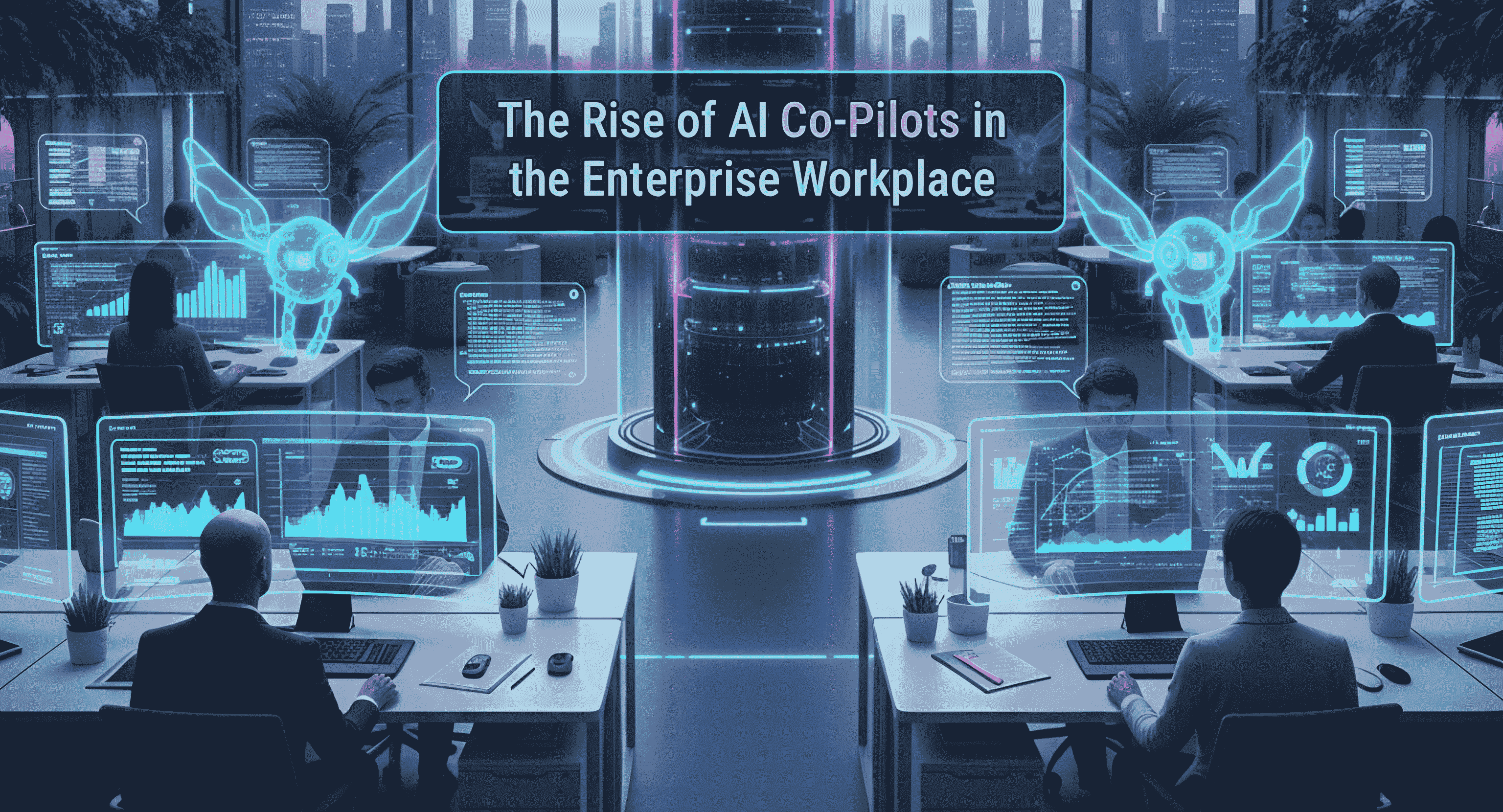
Artificial Intelligence is no longer confined to backend analytics or isolated automation tools. In today’s enterprise environment, AI is stepping directly into the daily workflow acting not as a replacement for employees, but as a collaborative partner. This evolution has given rise to a powerful concept: AI Co-Pilots.
AI co-pilots are intelligent assistants embedded within enterprise tools and platforms that augment human capabilities. They assist with writing, coding, data analysis, decision-making, scheduling, customer support, and more operating alongside employees in real time.
Rather than fully automating roles, AI co-pilots enhance productivity, improve accuracy, and reduce cognitive load. They represent a shift from “AI as automation” to AI as augmentation.
In this blog, we explore what AI co-pilots are, how they function in enterprise environments, their benefits, challenges, use cases, and how organizations can strategically deploy them to transform workplace productivity.
What Are AI Co-Pilots?
AI co-pilots are intelligent systems designed to assist professionals within their existing workflows. Unlike standalone AI applications, co-pilots are integrated into tools employees already use such as email platforms, project management systems, CRM software, development environments, and data dashboards.
They can:
- Draft and summarize content
- Generate reports
- Suggest code improvements
- Analyze data patterns
- Recommend decisions
- Automate routine processes
- Provide contextual insights
The defining feature of AI co-pilots is context awareness; they understand the task at hand and provide relevant assistance without requiring constant manual input.
Why AI Co-Pilots Are Gaining Enterprise Adoption
Several factors are accelerating the adoption of AI co-pilots in organizations worldwide.
1. Increasing Information Overload
Employees manage emails, documents, meetings, dashboards, and collaboration tools daily. AI co-pilots reduce this overload by organizing, summarizing, and prioritizing information.
2. Demand for Higher Productivity
Businesses seek scalable productivity gains without proportionally increasing workforce size. AI co-pilots enhance output without replacing talent.
3. Advancements in Generative AI
Recent breakthroughs in language and multimodal models have made AI capable of understanding complex context and generating high-quality outputs.
4. Hybrid and Remote Work
Distributed teams benefit from AI tools that streamline collaboration and documentation. AI co-pilots help enterprises work smarter, not harder.
How AI Co-Pilots Work
AI co-pilots combine multiple AI capabilities:
Contextual Data Access
They connect to enterprise systems emails, documents, CRM records, analytics platforms gaining contextual awareness.
Language Understanding
Natural language processing allows employees to interact conversationally with the system.
Task Automation
AI executes repetitive steps such as formatting reports, scheduling meetings, or categorizing support tickets.
Predictive Insights
Machine learning models identify patterns and recommend actions.
Continuous Learning
Over time, co-pilots adapt to user preferences and organizational workflows. This seamless integration allows AI to assist without disrupting productivity.
Enterprise Use Cases of AI Co-Pilots
1. Executive and Administrative Support
AI co-pilots:
- Summarize meetings
- Draft responses
- Schedule appointments
- Prepare briefing notes
Executives gain time to focus on strategic decisions.
2. Software Development
AI co-pilots assist developers by:
- Suggesting code completions
- Identifying bugs
- Writing documentation
- Generating test cases
This accelerates development cycles and reduces errors.
3. Sales and CRM Optimization
AI systems analyze customer interactions, recommend follow-ups, draft outreach emails, and provide predictive sales insights.
4. Customer Support
Co-pilots generate response drafts, analyze sentiment, and retrieve knowledge base information in real time improving resolution speed.
5. Data Analytics and Reporting
Instead of manually building reports, employees can ask AI to generate dashboards, interpret trends, and highlight anomalies.
6. HR and Talent Management
AI co-pilots assist with:
- Resume screening
- Interview scheduling
- Employee engagement analysis
- Performance documentation
Key Benefits of AI Co-Pilots
1. Enhanced Productivity: By automating routine tasks, employees can focus on high-value activities.
2. Improved Accuracy: AI reduces human errors in documentation, data analysis, and repetitive workflows.
3. Faster Decision-Making: Real-time insights enable quicker, more informed decisions.
4. Knowledge Accessibility: Co-pilots act as instant knowledge assistants, retrieving relevant information from enterprise systems.
5. Workforce Empowerment: Rather than replacing jobs, AI co-pilots elevate employee capabilities.
Governance and Human Oversight
Despite their capabilities, AI co-pilots require responsible implementation.
Organizations must ensure:
- Clear data access controls
- Transparent AI decision-making
- Compliance with privacy regulations
- Bias detection and mitigation
- Human validation for high-impact decisions
Maintaining human oversight ensures AI remains a supportive partner rather than an unchecked authority.
Implementation Challenges
While promising, deploying AI co-pilots across enterprises presents challenges:
Integration Complexity: Connecting AI to existing enterprise systems requires secure APIs and architectural planning.
Data Security Risks: Access to sensitive data demands strong encryption and governance controls.
Change Management: Employees may require training and cultural adaptation to fully leverage AI tools.
Customization Needs: Generic AI tools may not align perfectly with specific enterprise workflows. Strategic planning and experienced AI development teams help mitigate these risks.
Measuring the ROI of AI Co-Pilots
Enterprises adopting AI co-pilots often measure success through:
- Time saved per employee
- Increased output per team
- Reduced operational errors
- Improved customer satisfaction
- Faster project completion
Quantifiable productivity gains make AI co-pilots a compelling investment.
The Future of AI Co-Pilots
AI co-pilots are evolving rapidly. Future developments include:
- Multimodal capabilities (text, voice, vision integration)
- Proactive task recommendations
- Personalized AI agents per employee
- Cross-platform orchestration
- Collaborative multi-agent systems
As AI systems mature, co-pilots may become digital teammates embedded across all enterprise functions.
Strategic Considerations for Enterprises
Organizations planning to adopt AI co-pilots should:
- Identify high-impact use cases
- Define governance policies early
- Start with pilot implementations
- Measure performance continuously
- Scale responsibly
Successful AI co-pilot adoption is both a technological and cultural transformation.
Final Thoughts: Empowering the Enterprise Workforce
AI co-pilots represent a significant shift in how enterprises operate. By combining automation with contextual intelligence, these systems augment human capabilities, improve productivity, and enhance decision-making.
Rather than replacing employees, AI co-pilots empower them freeing time, reducing cognitive load, and enabling smarter collaboration.
If you’re planning to build enterprise AI co-pilot solutions, intelligent workflow automation systems, or custom AI-powered platforms, partnering with experienced AI professionals ensures seamless integration and long-term scalability. At Swayam Infotech, we design and deploy advanced AI-driven applications tailored to enterprise needs helping organizations harness AI responsibly and effectively.