Essential Feature Scope and Validation Criteria for MVP App
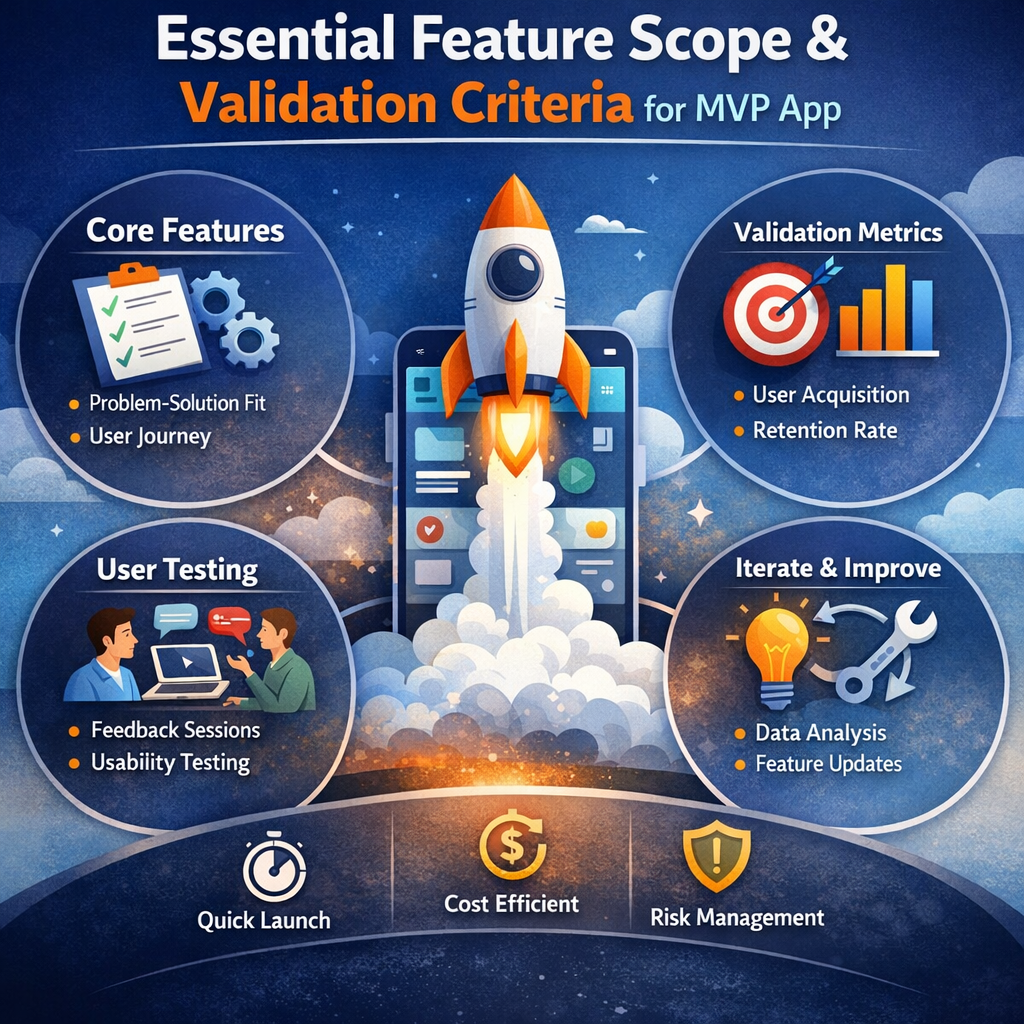
Launching a new digital product requires disciplined planning, structured validation, and a precise understanding of user priorities. An MVP approach allows organizations to test core assumptions before committing extensive resources to full-scale development. However, defining the right feature scope and validation criteria remains one of the most challenging aspects of early-stage product strategy. This article explores how to structure MVP features, set measurable validation benchmarks, and ensure that the product aligns with market expectations while maintaining operational efficiency.
Defining the Strategic Purpose of an MVP Product
An MVP is not a simplified version of a final product. It is a structured experiment designed to validate a business hypothesis. The objective is to determine whether a problem exists, whether users care about the solution, and whether the proposed value proposition resonates.
A well-defined MVP should:
-
Address a single, clearly articulated problem
-
Target a specific user segment
-
Deliver measurable value
-
Generate actionable data
The strategic purpose must be documented before feature selection begins. Without a defined hypothesis, teams risk building unnecessary functionality that dilutes validation outcomes.
An experienced MVP App Development Company typically begins by conducting stakeholder workshops to align on assumptions, market positioning, and expected outcomes. This structured approach prevents scope creep and ensures that development remains tightly aligned with business goals.
Identifying Core Features That Drive Real Value
Feature prioritization is the most critical step in MVP planning. Many teams mistakenly include enhancements, secondary flows, and advanced automation that are not required for initial validation.
To determine essential features, consider the following framework:
-
Problem-Solution Fit
The feature must directly solve the primary user problem. -
User Journey Integrity
The feature should enable users to complete the core task without friction. -
Technical Feasibility
The feature must be achievable within reasonable time and resource constraints. -
Measurable Impact
The feature should generate quantifiable data to validate assumptions.
A helpful exercise is mapping features into three categories:
-
Must-have
-
Nice-to-have
-
Future-phase
Only must-have features should be included in the MVP scope. The goal is to build the smallest functional product that delivers meaningful value.
When planning through professional mobile app development services, teams often rely on feature scoring matrices that evaluate impact versus effort. This data-driven prioritization significantly reduces subjective decision-making.
Establishing Clear Validation Metrics and KPIs
An MVP without validation metrics is merely a reduced product, not a strategic experiment. Validation criteria must be defined before development begins.
Common validation metrics include:
-
User acquisition rate
-
Activation rate
-
Retention percentage
-
Task completion rate
-
Customer feedback score
-
Conversion to paid plan
Each metric should correspond to a specific hypothesis. For example, if the hypothesis is that users will frequently use a productivity feature, then daily active usage and retention become primary indicators.
Quantitative metrics should be complemented by qualitative insights such as user interviews, usability testing, and behavioral observation. These insights often reveal friction points that raw numbers cannot explain.
A competent MVP App Development Company ensures that analytics infrastructure is embedded from day one. Without data capture mechanisms, validation efforts lose precision.
Balancing Speed, Budget, and Technical Quality
Time-to-market is a fundamental advantage of MVP methodology. However, speed should not compromise architectural integrity. Poor technical decisions in early stages can create expensive refactoring requirements later.
Key considerations include:
-
Modular architecture for scalability
-
Clean code practices
-
API flexibility
-
Cloud-based infrastructure
-
Security compliance
While minimizing scope reduces cost, underestimating technical complexity may inflate the overall MVP app development cost due to rework. Therefore, technical planning should account for both immediate validation needs and potential scale.
Budget allocation should prioritize:
-
Core feature engineering
-
UI and UX clarity
-
Analytics integration
-
Quality assurance
Cutting corners in usability or stability can invalidate test results because users may abandon the app due to friction rather than lack of product value.
Designing User-Centric Workflows for MVP Apps
Even with limited features, the user experience must be intuitive. A minimal product should not feel incomplete or confusing.
Focus on:
-
Clear onboarding
-
Simple navigation
-
Minimal decision fatigue
-
Logical task progression
-
Immediate value delivery
Onboarding is particularly critical. Users should understand the product’s purpose within the first few interactions. Complex tutorials or excessive data entry reduce activation rates.
User flow mapping helps eliminate unnecessary steps. Each screen should support a direct outcome tied to the core hypothesis. When MVP scope expands beyond this path, validation clarity diminishes.
Professional teams from an MVP App Development Company often conduct rapid usability tests before launch to ensure the interface supports the intended behavioral outcomes.
Conducting Structured Market and User Testing
Validation requires exposure to real users under realistic conditions. Controlled testing environments rarely replicate actual market behavior.
Common MVP testing approaches include:
-
Closed beta with early adopters
-
Limited geographic release
-
Invitezonly access
-
Industry-specific pilot programs
During testing, teams should collect:
-
Behavioral analytics
-
Session recordings
-
User interviews
-
Support ticket data
-
Survey responses
It is essential to segment users to understand behavior across demographics and usage contexts. Different user types may interact with the same feature in varied ways.
Testing should not aim to confirm assumptions but to challenge them. Objective evaluation prevents confirmation bias, which can lead to premature scaling decisions.
Iteration Frameworks for Continuous Improvement
An MVP is not a one-time release. It is the starting point of a continuous improvement cycle. Iteration must be structured and data-driven.
A typical iteration cycle includes:
-
Data analysis
-
Hypothesis refinement
-
Feature adjustment or removal
-
A/B testing
-
Performance measurement
Feature removal is often overlooked but critical. If a feature does not support the primary value proposition, eliminating it improves clarity and focus.
Iteration should prioritize:
-
Enhancing high-performing features
-
Simplifying complex workflows
-
Addressing recurring user pain points
-
Improving technical stability
Short development sprints enable rapid adaptation. However, iteration must be guided by metrics rather than stakeholder preferences.
Risk Management and Scope Control in MVP Phases
MVP development carries inherent risks, including misaligned expectations, delayed timelines, and uncontrolled scope expansion.
Effective risk mitigation strategies include:
-
Clear documentation of feature boundaries
-
Formal change request processes
-
Stakeholder alignment meetings
-
Milestone-based delivery checkpoints
Scope creep often emerges when new ideas surface during development. While innovation is valuable, introducing unvalidated features compromises experimental integrity.
Risk assessment should address:
-
Market uncertainty
-
Technical dependencies
-
Integration challenges
-
Data security requirements
-
Regulatory considerations
A structured governance framework ensures that the MVP remains aligned with its original hypothesis.
Scaling Strategy After MVP Validation Success
If validation metrics meet predefined benchmarks, the product can transition into scaling mode. Scaling involves both technical expansion and strategic refinement.
Scaling considerations include:
-
Infrastructure enhancement
-
Feature expansion roadmap
-
Monetization strategy
-
Marketing alignment
-
Customer support readiness
Before scaling, teams must confirm that positive signals are statistically significant and sustainable. Short-term spikes in usage do not necessarily indicate long-term product-market fit.
Scaling should follow a phased roadmap:
-
Strengthen core feature performance
-
Expand complementary functionalities
-
Optimize operational processes
-
Broaden market reach
Maintaining disciplined feature prioritization during scaling prevents regression into complexity.
Conclusion
Developing a successful MVP requires disciplined scope definition, measurable validation criteria, and structured iteration processes. The objective is not to launch a reduced product but to test strategic assumptions with precision and clarity. By prioritizing core functionality, embedding analytics from the outset, and maintaining rigorous scope control, organizations can minimize risk while maximizing learning. When executed correctly, the MVP approach becomes a powerful framework for innovation, enabling informed decision-making and sustainable product growth grounded in real user behavior.

 Arabic
 French
 Spanish
 Portuguese
 Deutsch
 Turkish
 Dutch
Dutch
 Italiano
 Russian
 Romaian
 Portuguese (Brazil)
 Greek
Greek