How to Size a Motorcycle Racing Suit Correctly and Why Fit Matters More Than Brand
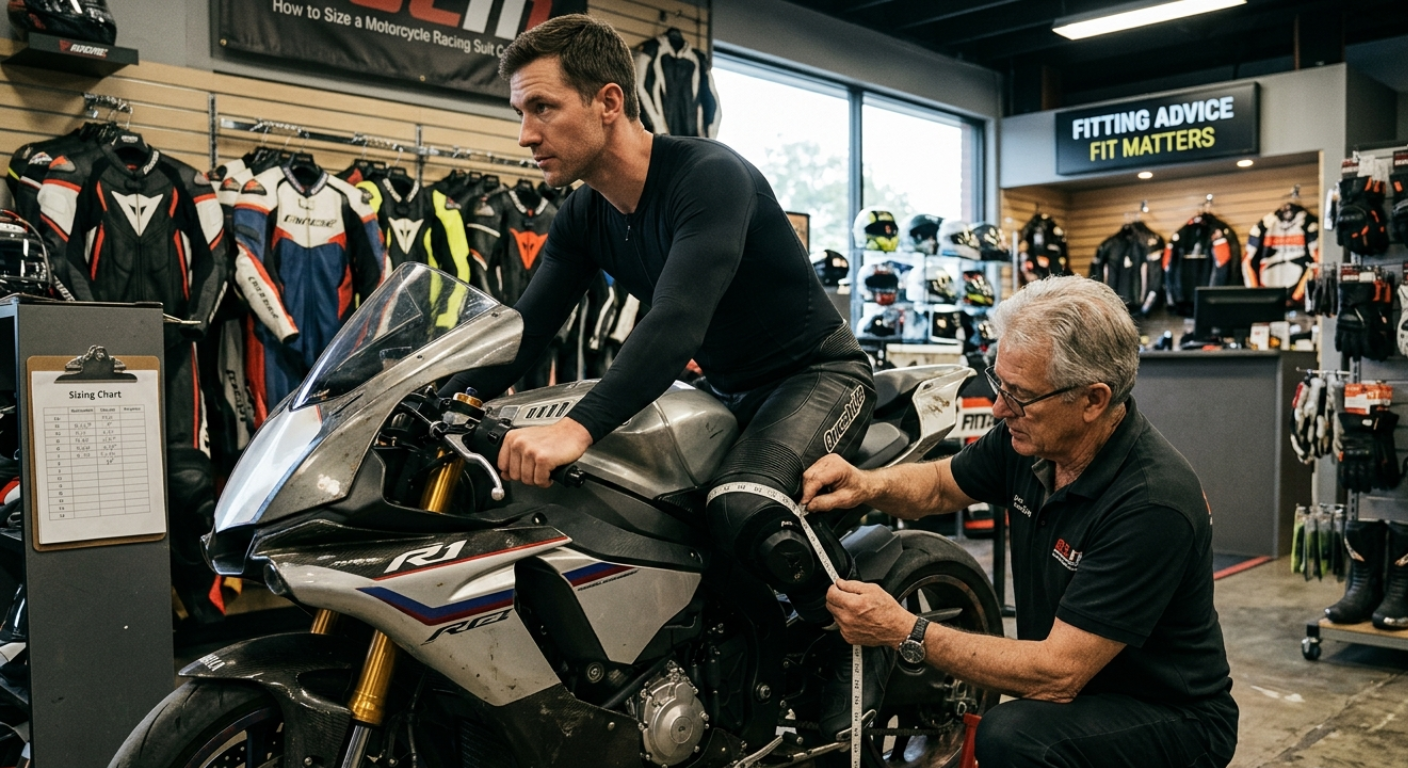
There is a conversation I have had more times than I can count over the years. A rider walks into a shop, picks up a suit from a well-known manufacturer, tries it on standing upright, decides it feels comfortable, and buys it. Three months later they are back with a story about how the armor shifted in a lowside and the knee protector ended up halfway down their shin.
The brand was not the problem. The fit was.
After decades in the motorcycle industry, I will tell you plainly that a perfectly fitted suit from a mid-tier manufacturer protects you better in a crash than a poorly fitted suit from the most prestigious name in racing. The brand determines the quality of the materials and the construction. The fit determines whether those materials actually do their job when it counts.
Why Getting the Fit Wrong Is a Safety Issue, Not Just a Comfort Issue
Most riders think of suit fit as a comfort consideration. They are wrong, and the research backs that up.
A published study in Accident Analysis and Prevention, drawing on data from 212 crashed motorcyclists, found that riders wearing motorcycle jackets with fitted body armor were significantly less likely to be hospitalized than those without. When the armor was properly fitted, the risk reduction for upper body injury was 23%, for legs 40%, and for hands and wrists 45%. The operative word throughout that study is fitted. Not worn. Fitted.
Loose armor shifts in a crash. This is not a theoretical concern. The physics are straightforward. When your body decelerates suddenly during a slide or impact, any component that is not secured against your body continues moving independently. A knee protector that starts 15mm above your kneecap and slides 20mm in a crash is now 35mm out of position, leaving the joint unprotected at the moment it needs coverage most.
A research note from the George Institute for Global Health found that a substantial proportion of motorcycle clothing items, specifically 28.1% of pants and 29.7% of jackets, were assessed to have failed under crash conditions due to material damage. Poorly fitted suits are significantly more likely to fall into that failure category because seams under tension from an incorrect fit are seams that are already stressed before the crash begins.
The Measurements You Actually Need Before You Buy
Most riders take one or two measurements and call it done. A chest measurement and a rough height. That works for a casual jacket. It does not work for a motorcycle riding suit where eight or nine separate dimensions determine whether the armor lands correctly.
The measurements that matter for a proper suit fit are:
• Chest circumference, taken at the fullest point under the arms
• Waist circumference, at the natural waistline rather than the hip
• Hip circumference, at the widest point
• Inseam length, from crotch to ankle
• Torso length, from the base of the neck to the natural waistline
• Shoulder width, from the outer edge of one shoulder to the other
• Sleeve length, from shoulder point to wrist with the arm slightly bent
• Height, measured without shoes
The measurements that most buyers skip and most regret are torso length and shoulder width. For a one-piece suit in particular, torso length is the single most consequential measurement. A one-piece that is too short in the torso will pull down at the back when you lean forward on the bike, creating exactly the gap at the lower spine that a one-piece design is supposed to eliminate.
Take every measurement in your base layers, not in outdoor clothing. If you plan to wear a compression undersuit beneath the racing suit, which is standard practice for track riding, take your measurements wearing that undersuit.
The Test That Showrooms Almost Never Do
This is where I watch most buyers go wrong. They try the suit on standing upright, do a couple of arm raises, maybe bend one knee, and make their decision. That test is effectively useless.
A motorcycle track suit is cut for the riding position, not for standing. The pre-curved sleeves, the forward lean in the torso, the articulated knee panels. All of that geometry is designed to put the suit into its correct shape when you are crouched over a fuel tank with your arms extended toward handlebars.
When fitting any motorcycle suit, do this:
• Sit on a stationary bike or get into a deep forward lean with arms extended
• Check that both knee armor pads sit precisely over the kneecap, not above or below it
• Check that elbow armor sits directly over the elbow joint, not on the forearm or upper arm
• Confirm the back of the suit stays fully in contact with your lower back when leaning forward, with no gap or riding up
• Check that shoulder armor sits on the shoulder joint, not shifted toward the neck or down the upper arm
• For a one-piece suit, verify you can reach a full handlebar extension without the suit pulling across the shoulders or lifting at the back
If the armor does not pass that test in riding position, the suit does not fit. Full stop.
Understanding the Break-In Factor
Leather stretches. This is a property of the material rather than a defect, and it affects how you should size your initial purchase.
A new leather motorcycle suit, whether cowhide or kangaroo, will feel noticeably snug. Industry fitting guidance consistently notes that leather stretches 3 to 5% over the first few riding sessions. For a rider with a 40-inch chest, that is approximately 1.5 to 2 inches of additional room that develops with use. Custom suit makers typically factor this into their pattern cutting, but off-the-shelf buyers need to account for it at purchase.
The practical implication is that if you are between two sizes and the larger size feels comfortable in the shop, you are buying a suit that will feel loose after break-in. Go with the snugger option, provided it does not restrict full riding-position movement. Snug in the shop becomes correctly fitted after a few sessions. Comfortable in the shop becomes sloppy on the track.
The break-in rule applies primarily to leather. Textile suits do not have the same stretch properties and should feel correct at purchase rather than requiring a period of adjustment.
How Brand Sizing Varies and Why You Cannot Assume Your Size
This is the practical problem that catches experienced riders as often as beginners.
A size Large from one manufacturer is not a size Large from another. Sizing conventions differ significantly between European, American, and Asian manufacturers. Even within a single brand, sizing can shift between suit lines as construction methods evolve.
The only reliable approach is to take your own measurements and compare them directly to the brand's specific size chart for the specific suit you are buying. Not a generic size chart. Not last year's chart. The chart for that model.
For made-to-measure suits, this step is handled by the manufacturer. Brands that offer custom construction cut the suit to your measurements directly, which eliminates the brand sizing variable entirely and ensures that armor placement is calibrated to your actual joint positions rather than to a size block averaged across thousands of customers. If you are at the outer range of standard sizing, or if your proportions mean that your chest and waist measurements point toward different sizes, made-to-measure is not a premium option. It is a functional necessity.
The motorcycle leather suits at Oneehide are built on a made-to-order model precisely for this reason. A suit cut to your measurements removes the variables that cause armor misalignment in standard sizing.
Airbag Compatibility and Why It Changes the Fit Calculation
If you are buying a suit with the intention of using an integrated airbag system, the fit calculation changes significantly and most buyers do not know this.
Airbag systems from manufacturers such as Tech-Air and In&Motion deploy in milliseconds and require a specific volume of space between the suit and your torso to inflate correctly. A standard airbag vest adds approximately 1 to 2 sizes to your chest measurement, and the suit must allow 5 to 7 centimeters of expansion room for the airbag to inflate and provide full coverage.
If you size your suit for a tight racing fit without accounting for the airbag vest, the system either cannot deploy fully or inflates with insufficient coverage across the collarbone, shoulders, and ribs. The airbag does not fail catastrophically. It simply does not protect the area it was designed to protect. Buying the suit and the airbag system together, and fitting both simultaneously, is the only correct approach.
What to Check After Every Season
A suit that fits correctly when new does not necessarily fit correctly two seasons later. Bodies change. Leather ages. Armor compresses.
At the start of each riding season, put the suit on in riding position and repeat the armor placement checks described above. If knee or elbow armor has shifted even slightly from its original position, inspect the internal pockets and retention systems. Armor pockets in cheaper suits can degrade over time, allowing inserts to move. This is a maintenance issue that takes five minutes to identify and potentially prevents a significant injury.
If you want to understand why this seasonal check matters beyond common sense, the peer-reviewed study on motorcycle protective clothing published in Accident Analysis and Prevention found that nearly 29% of jackets assessed after real crashes had failed due to material damage — many of which were suits that showed no obvious wear before the incident.
After any crash that involves suit contact with the road, the suit needs professional assessment before further use. Even where the outer leather shows no visible damage, the armor inserts may have absorbed impact energy and compressed permanently. Armor that has compressed once does not recover to its original energy-absorbing capacity. It needs replacing.
The Relationship Between Fit and Track Day Regulations
This is a point that surprises a number of riders who come to track days without having read the entry requirements carefully.
Most organized track days and circuit racing events specify minimum gear standards, and many scrutineers will physically check that your suit fits correctly, not just that it carries the right certification label. A CE AAA certified suit that is visibly too large, with armor pads sitting away from joint positions, can fail scrutineering at a well-run track day because the certification on the label does not account for incorrect fit.
The FIM Technical Regulations define minimum requirements for race suits used in competition, but correct fit is assumed as a baseline condition of compliance. A suit that does not fit does not comply with the intent of the regulation, regardless of the certification label it carries. Understanding this before you arrive at the circuit saves time and prevents the frustration of turning up in gear you cannot legally use.
One Last Thing About Brand Loyalty
After everything above, I want to address the brand question directly because it comes up constantly.
Buy the suit that fits your body. Not the suit with the most prestigious logo. Not the suit your riding hero wears on television. The suit that passes the armor placement test in your riding position, with the measurements to back it up.
Premium brands earn their reputation through materials quality, construction standards, and innovation. Those things matter. But a premium suit in the wrong size is a worse safety choice than a correctly fitted suit from a less famous manufacturer. Fit and armor placement are not variables that brand prestige can compensate for. Your body does not care whose name is on the back of the suit when it is sliding toward an armco barrier.
Get the fit right first. Then worry about everything else.