Introduction
Manufacturing is entering a new age of innovation, where speed, flexibility, and efficiency are becoming just as important as production volume. Businesses are under increasing pressure to develop products faster, reduce costs, strengthen supply chains, and meet growing sustainability expectations. To achieve these goals, manufacturers are turning to advanced technologies that can modernise traditional production processes.
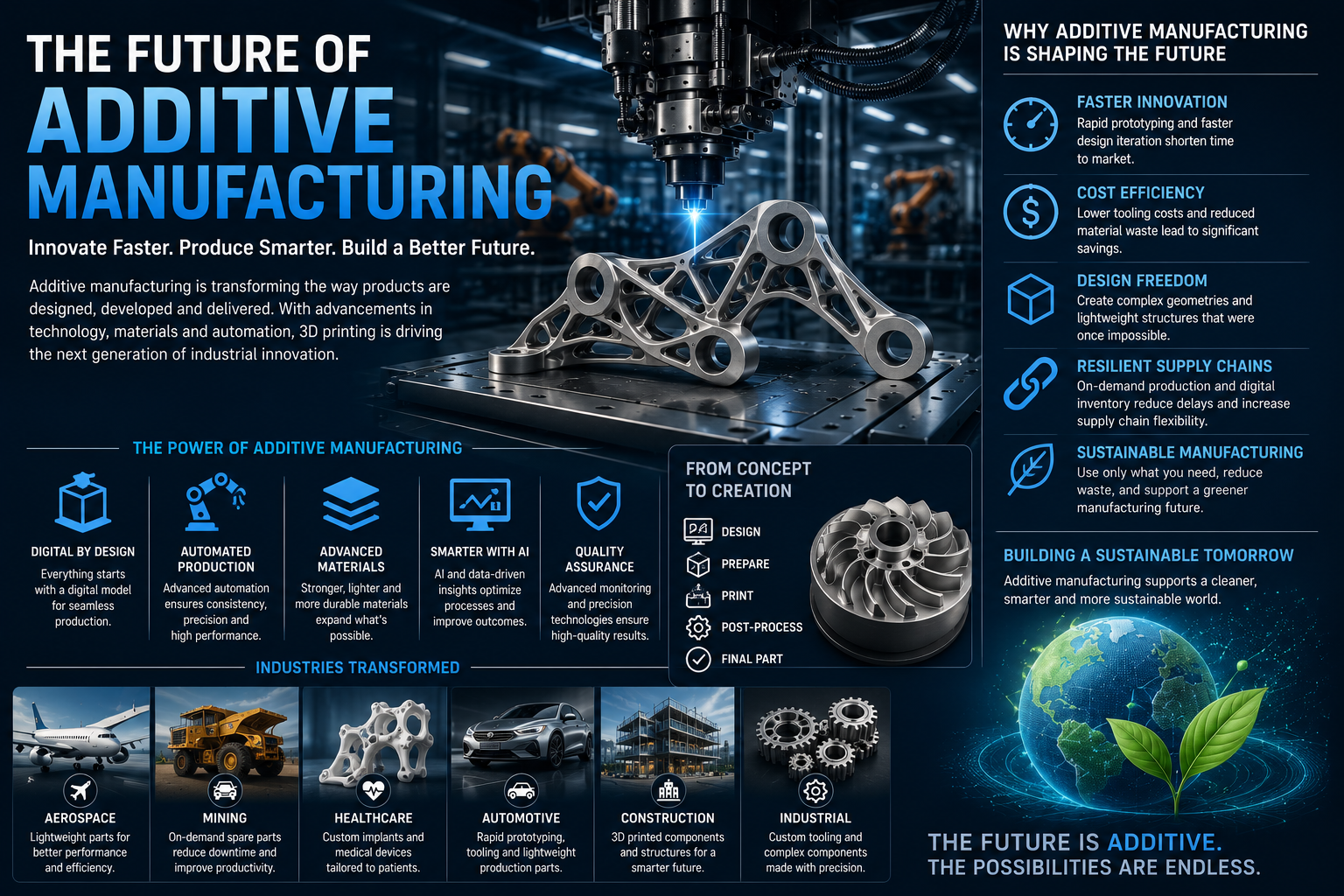
One of the most influential technologies leading this transformation is additive manufacturing. Better known as 3D printing, additive manufacturing is changing how products are designed, engineered, and manufactured. From rapid prototyping to full-scale production, the technology is helping businesses create smarter manufacturing systems that are ready for the future.
The Evolution of Additive Manufacturing
When additive manufacturing first emerged, it was primarily used for creating concept models and prototypes. Engineers could quickly test ideas without investing in expensive tooling or production equipment.
Today, the technology has evolved significantly.
Modern additive manufacturing systems are capable of producing:
- Functional prototypes
- Production tooling
- End-use components
- Customised products
- Industrial spare parts
- Complex engineering assemblies
This evolution has transformed additive manufacturing from a supporting design tool into a critical production technology.
Why Manufacturers Are Embracing 3D Printing
Several factors are driving the rapid adoption of additive manufacturing across industries.
Increasing Demand for Speed
Product life cycles are becoming shorter, and businesses must innovate faster to remain competitive.
Additive manufacturing allows manufacturers to move from concept to production in a fraction of the time required by traditional methods.
Rising Production Costs
Traditional manufacturing often requires significant investments in moulds, fixtures, and specialised tooling.
Additive manufacturing eliminates many of these costs, making production more accessible and cost-effective.
Greater Product Complexity
Modern products are becoming more sophisticated and often require complex geometries that are difficult to manufacture conventionally.
3D printing allows engineers to create highly intricate designs without increasing production complexity.
The Future Will Be Digital
Digitalisation is transforming every aspect of manufacturing.
Future production environments will rely heavily on:
- Digital product designs
- Cloud-based production systems
- Artificial intelligence
- Smart automation
- Real-time monitoring
Additive manufacturing is uniquely positioned to support this transition because every production process begins with a digital file.
This digital foundation enables greater connectivity, efficiency, and manufacturing flexibility.
Artificial Intelligence and Additive Manufacturing
Artificial intelligence is expected to become one of the biggest drivers of additive manufacturing innovation.
AI systems can help businesses:
- Optimise product designs
- Predict manufacturing performance
- Improve quality control
- Reduce production waste
- Automate workflow management
By combining AI with additive manufacturing, manufacturers can create smarter production systems that continuously improve efficiency and product quality.
On-Demand Manufacturing Becomes the New Standard
One of the most exciting aspects of additive manufacturing is its ability to support on-demand production.
Traditional manufacturing often requires businesses to produce large quantities of products and maintain extensive inventories.
With additive manufacturing, companies can manufacture parts exactly when they are needed.
Benefits include:
- Lower inventory costs
- Reduced warehousing requirements
- Faster response times
- Improved cash flow
- Reduced product obsolescence
As businesses seek leaner operations, on-demand manufacturing will become increasingly common.
The Expansion of Advanced Materials
The future of additive manufacturing is closely linked to developments in material science.
Industrial 3D printing systems now support a growing range of materials, including:
- High-strength polymers
- Carbon fibre composites
- Engineering-grade nylon
- Stainless steel
- Aluminium
- Titanium
Future materials will offer even greater performance characteristics, enabling additive manufacturing to expand into more demanding industrial applications.
This will further increase adoption across manufacturing sectors.
Strengthening Local Manufacturing
Recent supply chain disruptions have encouraged businesses to rethink their manufacturing strategies.
Additive manufacturing supports local production by enabling companies to manufacture parts closer to customers and operations.
Advantages include:
- Reduced shipping delays
- Faster production turnaround
- Lower transportation costs
- Improved supply chain resilience
- Greater manufacturing independence
As governments and businesses continue investing in domestic manufacturing capabilities, additive manufacturing will play a crucial role.
Sustainability Will Continue Driving Growth
Environmental responsibility is becoming a major focus for manufacturers worldwide.
Additive manufacturing contributes to sustainability through:
- Reduced material waste
- Efficient resource utilisation
- Lower transportation emissions
- Local production capabilities
- Lightweight product designs
Because products are built layer by layer, material is used more efficiently than many traditional manufacturing processes.
This makes additive manufacturing an attractive option for businesses pursuing sustainability goals.
Industries Leading the Way
Aerospace
Aircraft manufacturers are using additive manufacturing to produce lightweight components that improve fuel efficiency and performance.
Healthcare
Medical providers are creating customised implants, surgical guides, and patient-specific solutions through advanced 3D printing technologies.
Mining
Mining operations use additive manufacturing to quickly produce replacement parts and minimise costly downtime.
Automotive
Vehicle manufacturers continue to use additive manufacturing for rapid prototyping, tooling, and specialised production applications.
Construction
Large-scale additive manufacturing is opening new opportunities for building components and infrastructure projects.
Challenges and Opportunities
While additive manufacturing offers enormous potential, challenges remain.
Key areas for continued development include:
- Workforce training
- Industry standards
- Material certification
- Process validation
- Production scalability
Fortunately, ongoing investment in research and technology continues to address these challenges and expand industrial adoption.
Conclusion
The future of additive manufacturing is about far more than producing parts with a 3D printer. It represents a shift toward smarter, more connected, and highly efficient manufacturing systems capable of meeting the demands of modern industry.
As digital technologies, artificial intelligence, automation, and advanced materials continue to evolve, additive manufacturing will become an increasingly important part of global production strategies. Businesses that embrace these innovations today will be better positioned to reduce costs, improve flexibility, strengthen supply chains, and drive future growth.
The next generation of manufacturing is already taking shape—and additive manufacturing is leading the way.